
Salesforce Agentforce Revenue Management Summary
- What it is: Salesforce Agentforce Revenue Management (ARM) is an AI-powered platform that automates pricing, billing, contract management, and revenue recognition across the entire quote-to-cash lifecycle.
- Key capabilities: Intelligent pricing automation, usage-based billing, contract lifecycle management, revenue recognition, and real-time forecast updates.
- Who benefits: SaaS companies, subscription businesses, finance teams, revenue operations professionals, and enterprises with complex monetization models.
- Main advantage: Eliminates manual revenue processes, reduces billing errors, and accelerates the entire revenue lifecycle from quote to cash.
- ROI focus: Reduces operational costs, improves forecast accuracy, and enables complex pricing strategies at scale.
Your finance team is buried in manual work like generating quotes, calculating billing adjustments, reviewing contracts, and posting revenue recognition entries. Month-end close drags on for days, errors slip through, and you’re hiring just to keep up.
Salesforce Agentforce Revenue Management (ARM) eliminates this burden. It handles invoicing, billing adjustments, and revenue recognition automatically. Pricing runs against live customer data, contract compliance checks happen instantly, and revenue forecasts update in real-time.
This guide covers what ARM is, how it works, when to use it, and how to calculate ROI. From simple subscription billing to tiered pricing with usage overages, ARM manages the complexity so your team can focus on strategy.
What Is Salesforce Agentforce Revenue Management?
Salesforce Agentforce Revenue Management (ARM) is an AI-driven solution designed to automate the entire revenue operations lifecycle.
Unlike traditional configure-price-quote (CPQ) tools that focus narrowly on quoting, Agentforce Revenue Management extends automation from pre-sale pricing decisions through post-sale billing, renewals, and revenue recognition, building on the foundation of Salesforce Revenue Cloud.
Definition and Core Purpose
ARM combines AI agents with deep Salesforce ecosystem integration to handle routine revenue operations tasks that typically require manual oversight.
The platform uses intelligent automation to manage pricing logic, billing adjustments, contract compliance, and financial reporting tasks that traditionally consume significant operational bandwidth.
Organizations new to AI agents often start with a guided Salesforce Agentforce implementation to configure these intelligent workflows correctly from day one.
How ARM Works as an AI-Powered Revenue Tool
Agentforce Revenue Management operates by continuously monitoring your revenue data and responding to predefined business rules without human intervention.
When a customer’s usage changes, a contract term requires verification, or a billing adjustment is needed, ARM’s AI agents detect the scenario and execute the appropriate workflow automatically. To understand the underlying agent architecture in more detail, see our breakdown of how Agentforce works across business workflows.
This differs fundamentally from traditional revenue tools, which are reactive and require manual trigger points. ARM is proactive: it identifies opportunities for upsells, flags renewal risk, and adjusts forecasts in real-time based on live business signals.
Key Differences Between ARM and Traditional CPQ
Traditional CPQ platforms (like Salesforce’s legacy solution) excel at one task: generating accurate quotes. Agentforce Revenue Management goes further. It bridges the gap between sales and finance by automating decisions and workflows that previously required handoffs between teams.
While CPQ stops at the signed contract, ARM continues through billing, payments, and revenue recognition, maintaining data accuracy and business logic throughout. Teams transitioning from legacy quoting tools can follow a structured Salesforce CPQ to Revenue Cloud migration path to unlock this end-to-end automation.
Salesforce Agentforce Revenue Management (ARM) Key Capabilities
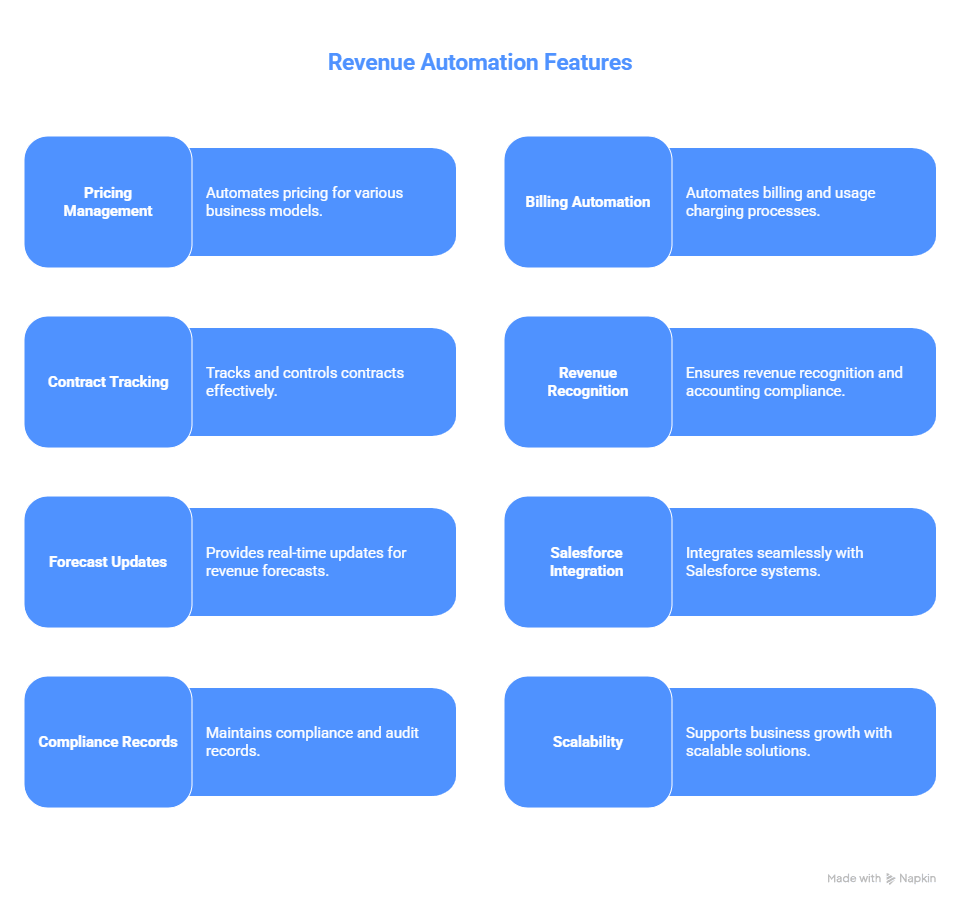
Salesforce Agentforce Revenue Management is a revenue system that automates pricing, billing, contracts, forecasting, and compliance. It operates within the Salesforce environment and helps manage revenue processes with less manual effort.
AI-Based Revenue Automation in Real Time
ARM automates pricing, billing, and contract actions using AI agents. It processes large volumes of transactions every day without human input, while keeping actions consistent and traceable.
Instead of running in batches, it updates information as soon as new orders, usage, or customer activity happens.
Pricing Management for Different Models
ARM applies pricing rules during quote and order creation based on contracts, customer type, and business rules.
It supports subscription pricing, tiered pricing, volume-based pricing, usage-based pricing, promotional pricing, regional pricing, and bundled products. This helps keep pricing consistent across all sales channels.
Billing and Usage Charging Automation
ARM manages billing cycles without manual effort. It creates invoices, applies adjustments, and handles subscription renewals automatically.
It supports multi-currency billing, taxes, credits, refunds, and one-time charges. For usage-based models, it collects usage data, calculates charges, and applies overage fees based on actual consumption.
Contract Tracking and Control
All quotes and orders follow a contract process that records terms, renewal dates, pricing rules, and conditions.
Any change request is checked against contract rules before approval to prevent errors or rule violations.
Revenue Recognition and Accounting Compliance
ARM handles revenue recognition based on standards like ASC 606 and IFRS 15. Revenue is recorded across the contract period as required.
It also creates journal entries, reduces manual accounting work, and supports audit preparation with accurate financial records.
Revenue Forecast Updates
ARM updates revenue forecasts as new data comes in, such as orders, usage, and customer changes.
This helps teams see current revenue status without waiting for monthly reports.
Integration with Salesforce Systems
ARM works inside the Salesforce system and shares data across sales, finance, and operations, often drawing on the unified records maintained in the Salesforce Data Cloud platform for a single source of customer truth.
This reduces separate data storage and keeps customer and revenue information consistent across teams.
Compliance and Audit Records
ARM records every action, including pricing changes, billing updates, contract approvals, and revenue adjustments.
These records support audits and compliance checks when needed.
Scalability for Business Growth
ARM can handle growth from small billing volumes to millions of transactions without changing the core setup.
Pricing rules, billing processes, and revenue recognition continue to run the same way as volume increases.
How Salesforce ARM Works Across the Revenue Lifecycle
Pre-Sale and Sales Execution
Pricing Intelligence and Dynamic Updates
When a sales rep opens a quote, ARM evaluates the customer’s historical spend, contract terms, and applicable discounts. The system recommends optimal pricing based on deal size, customer segment, and strategic priorities.
If market conditions change or competitor intelligence emerges, ARM can refresh pricing recommendations without requiring sales to manually recalculate.
Usage-Based Price Calculations
For customers billed on consumption, ARM calculates projected usage-based pricing during quoting based on historical usage patterns or customer-provided estimates. This transparency accelerates deal cycles and reduces post-sale billing disputes.
Contract and Order Execution
Contract Term Verification
Once a customer accepts a quote, ARM verifies that the proposed product changes don’t violate existing contract terms. If a customer wants to downgrade within a contract lock-in period, the system flags the conflict and routes it to the appropriate approver.
Automated Order Processing
ARM converts signed contracts into orders and routes them to fulfillment, automatically applying billing start dates, activation schedules, and service provisioning workflows.
Post-Sale and Customer Expansion
Billing Adjustments and Renewals
As the subscription term progresses, ARM monitors usage data and automatically applies adjustments. When renewal periods approach, the system generates renewal quotes with updated pricing based on contract terms and usage history.
Upsell and Cross-Sell Recommendations
Agentforce Revenue Management analyzes customer usage patterns and contract terms to recommend expansion opportunities. If a customer is approaching their license limit or usage tier, the system alerts sales teams with a pre-built expansion quote.
Common Use Cases for Agentforce Revenue Management
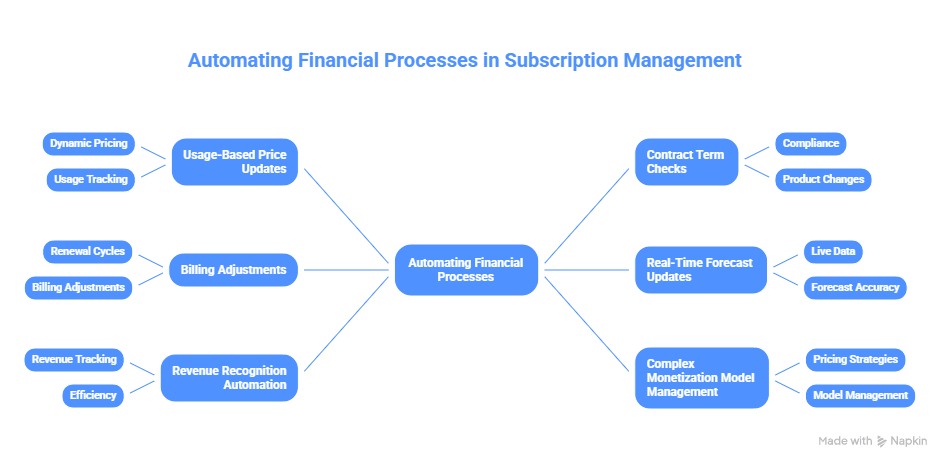
Automating Usage-Based Price Updates
A SaaS company bills customers based on API calls consumed. ARM ingests monthly usage data from the metering system, calculates overage charges, applies committed usage discounts, and generates invoices automatically.
Customers receive accurate billing without manual reconciliation. Digital storefronts pair this with Agentforce for commerce to extend the same automation logic into checkout, subscription upgrades, and order management flows.
This pattern is especially common in industrial settings, where teams adopting Agentforce for manufacturing use similar agent-driven logic to manage configure-to-order pricing and field service contracts.
Contract Term Checks During Product Changes
A customer requests to downgrade their subscription mid-contract. ARM checks the contract terms, verifies whether downgrades are permitted, and either approves the change or flags it for legal/finance approval based on configured rules.
Billing Adjustments During Renewal Cycles
As renewal approaches, ARM detects that the customer’s usage has grown 40% year-over-year. The system automatically generates a renewal quote reflecting the usage increase, suggests a tier upgrade based on actual consumption, and routes the renewal to the sales team with supporting data.
Real-Time Forecast Updates From Live Data
Instead of waiting for a monthly close process, ARM updates revenue forecasts daily based on new orders, churn data, and usage trends. Finance teams see accurate, dynamic forecasts that inform cash flow planning.
Revenue Recognition Automation
A customer signs a three-year contract with annual price increases. ARM schedules revenue recognition across the contract term, applies the ASC 606 standard, and generates journal entries automatically each quarter.
Complex Monetization Model Management
A company offers tiered, commitment-based pricing with usage overages, annual true-ups, and volume discounts. ARM evaluates all applicable pricing rules, applies them consistently, and manages billing adjustments as usage changes throughout the year.
Billing and Revenue Operations with Salesforce ARM
Billing Automation Capabilities
Automated Invoice Generation
ARM generates invoices based on billing schedules, usage data, and contract terms. The system applies the correct billing address, currency conversion, and tax rates without manual intervention.
Payment Reconciliation
When payments arrive, ARM matches them to invoices, applies credits, and flags discrepancies. Failed payment attempts trigger automated retry workflows, reducing bad debt and accounts receivable friction.
Multi-Currency and Tax Handling
For global businesses, ARM handles multi-currency transactions, applies regional tax rates, and manages compliance with local billing regulations automatically.
Revenue Recognition Features
Compliance With Accounting Standards
Agentforce Revenue Management applies IFCC 15 (ASC 606) revenue recognition rules automatically. The system tracks performance obligations, recognizes revenue as services are delivered, and handles complex scenarios like performance-based pricing or milestone-driven contracts.
Financial Visibility and Reporting
ARM provides real-time dashboards showing recognized revenue, deferred revenue, contract backlog, and cash flow projections. Finance teams export data directly to GL systems or data warehouses without manual reconciliation.
Cash Flow Management
ARM improves cash visibility by automating invoicing, payment collection, and reconciliation. Automated dunning sequences reduce days sales outstanding (DSO), and real-time payment tracking helps teams forecast cash flow accurately.
Pricing Strategy and Monetization in Salesforce ARM
Usage-Based Pricing Models
Companies billing on consumption use ARM to ingest metering data, calculate overage charges, apply tier adjustments, and generate billing automatically. The system handles complex scenarios like committed usage with overage charges or annual true ups.
Recurring Revenue Management
ARM manages subscription renewals, price increase schedules, and commitment periods. As renewal dates approach, the system generates renewal quotes reflecting contract terms and usage growth.
Bundled and Complex Product Offerings
For companies selling bundled products with component-level pricing, ARM maintains pricing consistency and correctly allocates revenue across components based on standalone selling prices or waterfall logic.
Dynamic Pricing Adjustments
Agentforce Revenue Management supports dynamic pricing based on customer segment, deal size, or competitive factors. Sales teams can request pricing exceptions through ARM, which evaluates them against margin targets and approval thresholds before approving or escalating.
Tiered and Volume-Based Pricing
ARM automatically applies volume discounts, tiered pricing, and commitment discounts based on order size and customer classification. As customer usage grows, the system recommends tier upgrades and handles the transition automatically.
Contract Lifecycle Management in Salesforce ARM
Contract Creation and Execution
Salesforce Agentforce Revenue Management creates contracts from approved quotes, populating all contract terms, renewal dates, and pricing schedules automatically. Teams access a single source of truth for all contract details.
Automated Term Verification
Before any product change is approved, ARM verifies the request against contract terms. If the request violates a lock-in period, commitment level, or renewal clause, the system routes approval to finance or legal based on configured rules.
Compliance and Legal Tracking
ARM maintains audit trails of all contract changes, approvals, and amendments. This compliance visibility simplifies audits and ensures legal teams have visibility into all customer commitments.
Renewal and Amendment Workflows
When contracts approach renewal, ARM generates renewal quotes with updated pricing. If a customer requests mid-term amendments, the system routes approval workflows based on change type and financial impact.
Integration Capabilities of Salesforce ARM
How ARM Integrates With Salesforce Revenue Cloud
Agentforce Revenue Management is built natively into Salesforce Revenue Cloud, providing seamless data flow between quoting, order management, billing, and revenue recognition. Revenue Cloud becomes the central hub for all revenue operations.
Third-Party System Integration
ARM integrates with ERP systems (NetSuite, SAP), accounting platforms (Xero, QuickBooks), payment gateways (Stripe, PayPal), and subscription billing platforms (Zuora, Aria) via APIs or pre-built connectors.
Companies with complex back-office environments often rely on dedicated Salesforce integration services to design and maintain these connections at enterprise scale.
Data Flow and Synchronization
When a quote is approved in ARM, the system creates an order in ERP, triggers fulfillment, and initiates billing setup. Real-time data sync ensures all systems reflect the current state without manual reconciliation.
API and Middleware Considerations
Custom integrations use REST APIs, webhooks, or MuleSoft (Salesforce’s integration platform) to synchronize data between ARM and external systems. Complex integration scenarios may require middleware like Boomi or Workato.
Limitations and Boundaries of Agentforce Revenue Management
Data Quality Requirements
ARM’s effectiveness depends on high-quality product catalogs, contract data, and usage metering. If pricing rules or customer data are inconsistent, ARM will execute consistently but against incorrect inputs.
Policy Ownership and Human Decision-Making
ARM executes pricing and billing according to configured rules, but humans must define those rules. Strategic pricing decisions, margin targets, and contract exception policies remain human responsibilities.
Strategic and Compliance Boundaries
ARM cannot override compliance requirements or execute decisions outside defined guardrails. Contract approval workflows, legal review steps, and financial approval thresholds remain manual handoffs when required.
When to Use Manual Processes vs. AI Agents
High-volume, rule-driven transactions (invoicing, renewal quotes, usage-based billing adjustments) are ideal for ARM automation. High-touch, negotiation-intensive deals may still require manual workflows, with ARM handling the execution once terms are finalized.
Salesforce ARM vs. Competitor Solutions
ARM vs. Traditional CPQ Platforms
Traditional CPQ (including Salesforce’s legacy solution) generates quotes accurately but stops at contract signature. ARM continues through billing, revenue recognition, and customer expansion providing end-to-end automation.
ARM vs. Legacy Revenue Management Tools
Legacy solutions often require manual data entry, run batch processes nightly, and create silos between sales, finance, and operations. ARM automates the entire workflow, provides real-time updates, and integrates with Salesforce natively.
Competitive Advantages of Salesforce ARM
Agentforce Revenue Management leverages Salesforce’s AI infrastructure, existing customer data, and Revenue Cloud ecosystem. Companies already on Salesforce experience faster implementation, lower integration costs, and better data governance than with point solutions.
Why Salesforce Agentforce Revenue Management Matters
Eliminating Manual Revenue Processes
Finance teams spend significant time on manual invoicing, billing adjustments, and revenue recognition. ARM eliminates these labor-intensive tasks, freeing teams to focus on strategic analysis.
Improving Revenue Accuracy and Forecasting
Real-time data and automated calculations reduce billing errors and enable accurate, dynamic forecasting. Finance teams see revenue impact immediately rather than waiting for monthly close processes.
Accelerating Quote-to-Cash Cycles
With ARM automating quoting, contract verification, order creation, and invoicing, the entire cycle from quote to cash shortens from weeks to days. Faster cash collection improves working capital.
Reducing Billing Errors and Disputes
Automated billing based on contracts and usage data eliminates manual calculation errors. Customers see accurate invoices, reducing payment disputes and improving cash flow predictability.
Enabling Complex Monetization Strategies
Companies can confidently deploy sophisticated pricing models, usage-based billing, tiered commitments, and performance-based revenue because ARM handles the operational complexity automatically.
Who Should Use Salesforce Agentforce Revenue Management
Finance and Accounting Leaders
CFOs and controllers use ARM to improve revenue visibility, ensure compliance with accounting standards, and reduce month-end close cycles. Real-time revenue dashboards replace manual reconciliation.
Revenue Operations Professionals
RevOps teams deploy ARM to enforce pricing consistency, automate billing workflows, and eliminate manual data entry. RevOps becomes a strategic function focused on process optimization rather than firefighting.
Sales Teams
Sales leaders use ARM’s forecasting capabilities and expansion recommendations to accelerate growth. Faster quote generation and automated renewals shorten deal cycles.
SaaS and Subscription Companies
Subscription businesses with usage-based pricing depend on ARM to calculate overage charges, manage tier upgrades, and generate accurate monthly billing.
Businesses With Complex Pricing Models
Companies using tiered pricing, commitment discounts, performance-based revenue, or bundled offerings use ARM to enforce consistency and reduce manual pricing calculations.
IT and Systems Integration Teams
IT teams manage ARM integrations with ERP, accounting, and payment systems. Integration engineers configure data flows and ensure data quality across systems.
Salesforce Agentforce Revenue Management Pricing
Licensing Models and Costs
ARM licensing is typically transaction-based or usage-based (invoices generated, orders created, revenue recognized). Exact pricing varies by company size and transaction volume. Contact Salesforce for custom quotes.
Implementation and Configuration Costs
Implementation costs depend on complexity: simple configurations (standard subscription billing) may cost $50K–$100K, while complex setups (tiered pricing, usage-based billing, ERP integration) can exceed $200K.
ROI and Cost-Benefit Analysis
Most companies see ROI within 12–18 months through reduced labor costs, fewer billing errors, and improved cash flow. Cost savings of 30–50% in finance operational costs are typical for mid-market companies.
Getting Started With Salesforce ARM
Assessment and Planning
Audit your current revenue processes: identify manual steps, pain points, and data quality issues. Map your product catalog, pricing rules, and contract terms to ARM’s data model, ideally with input from an experienced Salesforce CRM consulting partner who can validate process gaps before configuration begins.
Configuration and Setup
Configure pricing rules, billing schedules, contract terms, and approval workflows in ARM, following a structured Salesforce Revenue Cloud implementation guide. This is a facilitated process with Salesforce or implementation partners.
Data Preparation
Migrate product catalogs, existing contracts, customer accounts, and usage data into ARM through structured Salesforce migration services. Data quality at this stage directly impacts the system’s accuracy and value.
Testing and Validation
Test billing scenarios, price calculations, revenue recognition, and integration workflows. Validate that ARM’s outputs match your expected business logic before going live.
Deployment and Monitoring
Deploy to production with a phased approach: start with new customers, then migrate existing contracts. Monitor billing accuracy, revenue recognition, and forecast updates during the first 90 days, optionally backed by ongoing Salesforce managed services to stabilize the rollout and tune rules over time.
Conclusion
Salesforce Agentforce Revenue Management transforms how companies manage revenue operations. By automating pricing, billing, contract management, and revenue recognition, ARM eliminates manual processes, reduces errors, and accelerates the entire revenue cycle.
Whether you’re managing simple recurring billing or complex tiered pricing with usage overages, Agentforce Revenue Management enables you to scale without adding headcount. The result: faster cash collection, accurate forecasting, and strategic finance operations.
Ready to streamline your revenue operations? Talk to our Salesforce specialists to assess whether ARM is right for your business. Book a consultation today to explore implementation timelines and ROI projections.
FAQs
What is Salesforce Agentforce Revenue Management (ARM)?
Salesforce Agentforce Revenue Management is an AI-powered platform that automates the entire revenue operations lifecycle from pricing and quoting through billing, renewals, and revenue recognition. It uses intelligent agents to execute routine revenue tasks without manual intervention.
How does Salesforce ARM differ from CPQ (Configure Price Quote)?
Traditional CPQ tools generate accurate quotes but stop at contract signature. Agentforce Revenue Management extends automation through the entire quote-to-cash cycle, including billing, revenue recognition, renewals, and expansion management.
What are the main features of Agentforce Revenue Management?
Core features include automated pricing logic, usage-based billing, contract lifecycle management, revenue recognition automation, real-time forecasting, and intelligent renewal/expansion recommendations.
How does ARM handle usage-based billing and pricing?
ARM ingests metering data from your application, automatically calculates usage-based charges, applies tier adjustments and committed usage discounts, and generates billing. No manual reconciliation needed.
Can ARM integrate with third-party systems and platforms?
Yes. ARM integrates with ERP systems (NetSuite, SAP, Oracle), accounting platforms (Xero, QuickBooks), payment gateways (Stripe, PayPal), and subscription billing platforms via APIs or pre-built connectors.
What data quality is needed to implement Salesforce ARM?
High-quality product catalogs, accurate contract terms, correct customer classifications, and reliable usage metering data are essential. ARM executes according to configured rules garbage in, garbage out.
What is the pricing model for Salesforce Agentforce Revenue Management?
Pricing is typically transaction-based (invoices, orders, revenue transactions) with volume discounts. Implementation costs vary by complexity: simple configurations $50K–$100K, complex setups $200K+.
Which companies benefit most from Salesforce ARM implementation?
SaaS companies with subscription or usage-based models, companies with complex pricing (tiered, commitment-based, bundled), and enterprises with high billing transaction volumes see the greatest ROI.