


Executive Summary
An equipment manufacturer had already invested in Salesforce but was not realizing the expected business value.
Sales and service processes were not sufficiently aligned, ERP integration created operational friction, and gaps in user acceptance testing (UAT) and user enablement affected adoption and productivity.
Instead of replacing Salesforce, the transformation focused on re-engineering the existing Salesforce environment.
The solution included Sales Cloud re-engineering, Service Cloud optimization, MuleSoft-based ERP integration, improved process alignment, and stronger UAT and user enablement.
Project materials report 35% faster sales operations.
The key takeaway for organizations with an existing Salesforce investment is:
When Salesforce is underperforming, the problem may be the architecture, integration, process design, or adoption model—not the platform itself.
The Business Problem: Salesforce Was Not Delivering the Expected Value
The manufacturer had Salesforce in place, but the platform was not producing the expected operational results.
The key issues included:
- Sales and service processes were not sufficiently aligned.
- ERP integration created operational barriers.
- Existing Salesforce processes required re-engineering.
- UAT was insufficient.
- User enablement was not strong enough.
- Sales productivity was constrained by disconnected processes.
This created friction across the customer lifecycle.
The issue was therefore not simply:
“Salesforce needs more features.”
The more important question was:
“Is Salesforce correctly designed around the business?”
Before Re-Engineering: Disconnected Enterprise Processes
The existing operating model contained gaps between Salesforce, ERP, sales, and service.
A simplified representation is:
Salesforce Sales Processes
↕
Disconnected Sales & Service Processes
↕
ERP Integration Barriers
↕
Enterprise Operations
Manual handoffs and integration limitations created additional operational friction.
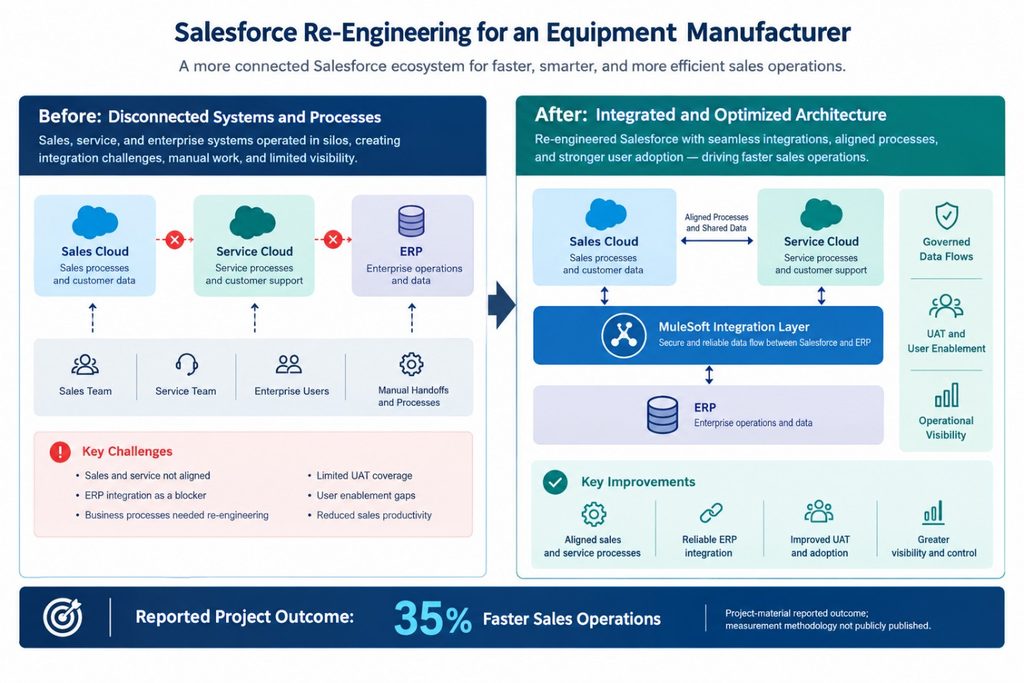
Salesforce Re-Engineering for an Equipment Manufacturer
Before-and-after architecture showing disconnected Salesforce and ERP processes transformed into an integrated Salesforce ecosystem using a MuleSoft integration layer.
The Salesforce Solution
1. Sales Cloud Was Re-Engineered
The solution focused on improving the existing Salesforce environment rather than simply adding more functionality.
Sales Cloud processes were re-engineered around the manufacturer’s business requirements.
The objective was to make Salesforce better aligned with the actual sales operating model.
That means addressing:
- Process design
- Data flow
- User experience
- Sales workflow
- Integration dependencies
- Operational visibility
This is fundamentally different from treating Salesforce as a collection of isolated features.
2. Salesforce and ERP Were Reconnected
ERP integration was a critical component of the transformation.
MuleSoft was used as part of the integration architecture to reconnect Salesforce with enterprise systems.
The target model was:
Salesforce → MuleSoft Integration Layer → ERP
This approach provides a defined integration boundary between the CRM and enterprise resource environment.
That matters because manufacturers commonly depend on multiple enterprise platforms for customer, product, order, financial, and operational processes.
The objective is not to duplicate every ERP function inside Salesforce.
It is to make the right information available to the right business process.
3. Service Cloud Was Optimized
Service Cloud was also optimized to create stronger alignment between sales and service.
Instead of operating as separate functions, the transformed environment connected customer-facing processes more effectively.
The target operating model became:
Sales → Customer → Service → Enterprise Systems
That creates a more complete customer lifecycle.
4. UAT and User Enablement Were Addressed
A Salesforce transformation is only successful when users can operate the resulting solution effectively.
The engagement addressed UAT and user enablement alongside the technical transformation.
This is important because even technically sound Salesforce architecture can underperform when:
- Business requirements are not adequately validated.
- Users are not prepared for process changes.
- Adoption is inconsistent.
- Existing workarounds remain in place.
Technology and adoption therefore need to be treated as one transformation.
After Re-Engineering: A Connected Salesforce Ecosystem
The resulting architecture can be represented as:
Sales Cloud
↕
Service Cloud
↕
MuleSoft Integration Layer
↕
ERP
Surrounding that architecture are:
UAT + User Enablement + Governance + Operational Visibility
The goal was a connected enterprise environment rather than isolated Salesforce functionality.
Defining System-of-Record Responsibilities
One of the most important principles of Salesforce architecture is avoiding unnecessary duplication.
A connected architecture should establish clear responsibilities.
| Business Area | Primary Role |
| Sales management | Salesforce Sales Cloud |
| Customer service | Salesforce Service Cloud |
| Enterprise resource processes | ERP |
| Cross-system integration | MuleSoft |
| Customer-facing operational processes | Salesforce |
The exact system-of-record design should always be determined by the organization’s requirements and enterprise architecture.
The important principle is:
Integrate systems around business processes instead of forcing one platform to become the system of record for everything.
Why Re-Engineering Can Be Better Than Replacing Salesforce
Replacing Salesforce is not automatically the answer when an implementation is underperforming.
If the underlying problems are:
- Poor process design
- Weak integrations
- Data fragmentation
- Limited adoption
- Insufficient testing
- Misaligned configuration
then replacing the platform may simply move the same problems to another technology.
Re-engineering takes a different path:
Diagnose → Redesign → Integrate → Validate → Enable → Measure
That can protect existing platform investment while addressing the actual causes of poor performance.
The Reported Business Impact
Project materials report:
35% Faster Sales Operations
The reported improvement reflects the broader re-engineering effort across Salesforce processes, enterprise integration, service alignment, UAT, and user enablement.
The 35% figure is reported in project materials. The underlying measurement methodology and baseline have not been publicly published.
What Manufacturing Leaders Should Take Away
A Salesforce implementation should be evaluated by business performance, not by whether the organization owns Salesforce licenses.
If users still rely on spreadsheets, manual workarounds, disconnected ERP processes, or duplicate data entry, the problem may lie in the implementation architecture.
Before replacing Salesforce, organizations should evaluate:
- Process architecture
- Data architecture
- Integration architecture
- User experience
- UAT coverage
- Adoption and enablement
- Governance
That analysis can reveal whether the platform itself is the problem—or whether the implementation needs to be re-engineered.
Frequently Asked Questions
Can Salesforce integrate with ERP systems?
Yes. Salesforce can integrate with ERP systems through APIs and integration platforms such as MuleSoft.
Should a manufacturer replace Salesforce if the implementation is underperforming?
Not necessarily. Organizations should first determine whether the underlying issue is platform suitability or implementation architecture.
What role can MuleSoft play in Salesforce ERP integration?
MuleSoft can provide an integration layer for exchanging information between Salesforce and enterprise systems while maintaining defined system boundaries.
Why are UAT and user enablement important?
UAT validates that the solution supports business requirements. User enablement helps employees adopt the resulting processes and reduces reliance on manual workarounds.
Conclusion
The manufacturer’s challenge was not simply a Salesforce functionality problem.
It was an architecture, integration, process, and adoption problem.
Re-engineering Sales Cloud, optimizing Service Cloud, reconnecting ERP integration through MuleSoft, and addressing UAT and user enablement created a more connected Salesforce ecosystem.
Project materials report 35% faster sales operations.
The broader lesson is equally important:
Before replacing Salesforce, determine whether the real problem is the platform—or the way the platform has been designed, integrated, and adopted.