


Executive Summary
A California-based glass, glazing, and door installation provider needed a more connected way to move from quoting to field execution.
Manual quoting, disconnected scheduling, limited job visibility, and limited mobile support created friction between sales, dispatch, and field teams.
The Salesforce solution connected CPQ, quote approval, work-order creation, Field Service scheduling, dispatch, mobile execution, and operational reporting.
Public Folio3 case material confirms the use of Salesforce CPQ, Field Service, mobile application development, workflow automation, dispatch optimization, and an automated quote-to-work-order process. It states that approved quotes automatically generated Field Service work orders, removing re-entry errors.
Project materials report 40% faster quote-to-cash.
The transformation therefore addressed a specific business problem:
The gap between selling the work and executing the work.
The Business Problem: Sales and Field Operations Were Disconnected
For a field-service business, winning a job is only the beginning.
After a quote is approved, the organization needs to:
- Create the work order.
- Schedule the work.
- Assign the right technician.
- Provide the technician with customer and job information.
- Execute the work.
- Capture updates.
- Maintain management visibility.
When these activities are disconnected, every handoff introduces potential delays and errors.
The provider faced:
- Manual quoting
- Manual data re-entry
- Disconnected scheduling
- Dispatch challenges
- Limited job visibility
- Limited technician visibility
- Limited mobile support
Public Folio3 case material confirms the broader need for better alignment between sales, dispatch, and field service.
Before Salesforce: Manual Commercial-to-Field Handoffs
The previous process can be summarized as:
Manual Quote
↓
Manual Re-Entry
↓
Work Order
↓
Disconnected Scheduling
↓
Dispatch
↓
Field Execution
Every manual transition created another opportunity for:
- Data-entry errors
- Delays
- Missing information
- Scheduling problems
- Communication gaps
- Limited management visibility
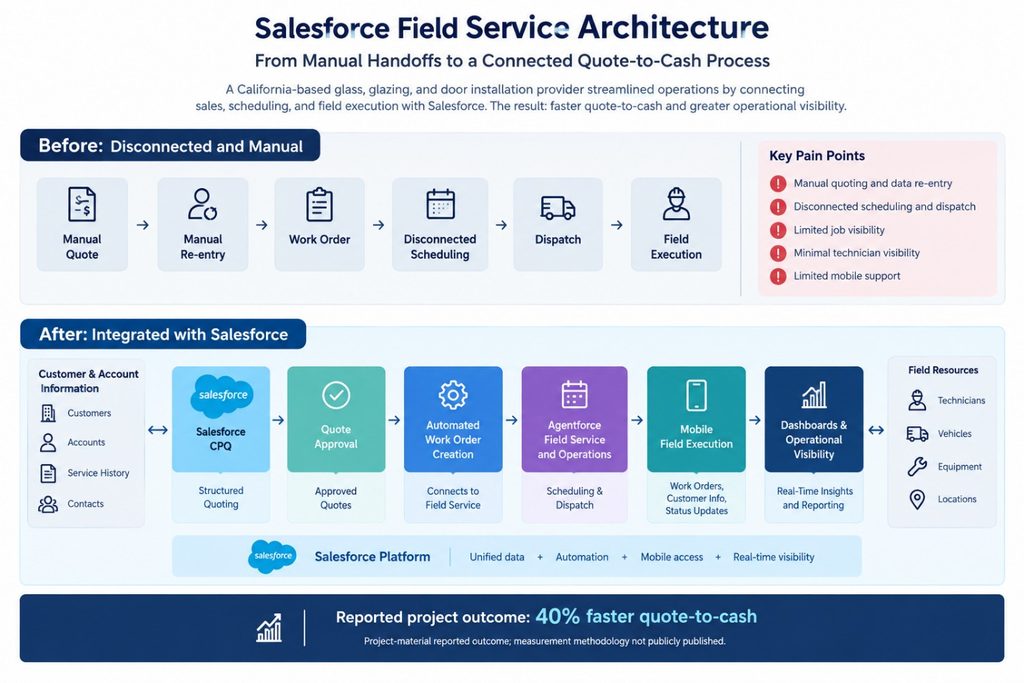
Salesforce Field Service Architecture — From Manual Handoffs to a Connected Quote-to-Cash Process
Before-and-after Salesforce architecture connecting CPQ, quote approval, automated work-order creation, Field Service scheduling, mobile field execution, dashboards, and field resources.
The Salesforce Solution
1. Salesforce CPQ Structured the Quoting Process
Salesforce CPQ was configured to provide a more structured approach to quoting.
The objective was to reduce inconsistency in the commercial process and create a cleaner transition from an approved quote to service execution.
Public Folio3 case material confirms Salesforce CPQ configuration and describes a structured quote process.
2. Approved Quotes Automatically Created Work Orders
This was one of the most important process improvements.
Instead of:
Approved Quote → Manual Re-Entry → Work Order
the process became:
Approved Quote → Automated Work Order Creation
Public Folio3 case material explicitly states that approved quotes automatically generated work orders in Field Service, removing re-entry errors and reducing delays created by manual handoffs.
This created a direct connection between commercial approval and operational execution.
3. Field Service Connected Scheduling and Dispatch
Salesforce Field Service was used to improve technician assignment, scheduling, routing, and dispatch.
Salesforce’s current Field Service platform supports work orders, scheduling, mobile workers, service territories, skills, and related field-service operations.
For this engagement, the objective was to create a more connected field-service workflow.
The operating sequence became:
Work Order → Scheduling → Technician Assignment → Dispatch → Field Execution
4. Mobile Access Connected Technicians to the Operation
Field technicians needed access to the information required to perform work without repeatedly depending on the office.
The solution included a custom mobile application supporting:
- Work orders
- Schedules
- Customer history
- Status updates
- Appointment confirmations
- On-site documentation
Public Folio3 case material confirms these mobile capabilities.
Salesforce Field Service also provides mobile functionality for field workers to access assigned service appointments and work-order information.
5. Dashboards Improved Operational Visibility
The solution also improved management visibility into field operations.
Dashboards supported visibility into areas such as:
- Technician productivity
- Job timelines
- Workloads
- Operational activity
This helped move management away from asking for status manually and toward using centralized operational information.
After Salesforce: A Connected Quote-to-Cash Architecture
The transformed process can be represented as:
Customer / Account Information
↓
Salesforce CPQ
↓
Quote Approval
↓
Automated Work Order Creation
↓
Field Service Scheduling & Dispatch
↓
Mobile Field Execution
↓
Dashboards & Operational Visibility
This architecture connects the commercial and operational lifecycle.
Why the Quote-to-Work-Order Connection Matters
The critical architectural improvement was eliminating an unnecessary manual handoff.
Before
Quote → Human Re-Entry → Work Order
After
Quote Approval → Automated Work Order
This matters because every manual re-entry creates the possibility of:
- Incorrect information
- Duplicate data
- Delayed work creation
- Lost context
- Additional administrative effort
The automated workflow allows the approved commercial transaction to become an operational work item without recreating the information manually.
Connecting the Office and the Field
Field-service transformation cannot stop at the back office.
The value increases when sales, dispatchers, technicians, and management operate from connected information.
The resulting operating model becomes:
Sales Team
↕
Salesforce CPQ
↕
Field Service
↕
Dispatcher
↕
Technician Mobile Experience
↕
Customer
That creates a continuous operational chain rather than separate departmental workflows.
The Reported Business Impact
Project materials report:
40% Faster Quote-to-Cash
The improvement reflects the broader transformation connecting quoting, approval, work-order creation, scheduling, dispatch, mobile execution, and operational visibility.
The public Folio3 case material additionally reports 35% higher technician productivity and a 25% reduction in average job time.
The 40% quote-to-cash figure is reported in project materials. The underlying measurement methodology and baseline have not been publicly published.
What Field-Service Leaders Should Take Away
The most important question for a field-service organization is not:
“Do we have a CRM?”
It is:
“Can we move from customer demand to completed field work without unnecessary manual handoffs?”
A well-designed Salesforce architecture can connect:
Quote → Approval → Work Order → Resource → Schedule → Technician → Job → Outcome
That is where Salesforce becomes more than a customer management system.
It becomes an operational workflow platform.
Frequently Asked Questions
How can Salesforce improve field-service operations?
Salesforce Field Service supports work orders, scheduling, dispatch, mobile workers, service resources, and field execution.
Can Salesforce CPQ connect to Field Service?
Yes. Salesforce can be configured to connect commercial processes with downstream service workflows. In this case, approved quotes automatically generated Field Service work orders.
How can Salesforce reduce manual quote-to-service handoffs?
Automation can transfer approved commercial information into downstream operational processes, reducing duplicate data entry and manual re-entry.
Why is mobile access important for field technicians?
Mobile access allows technicians to work with assigned service appointments, work orders, schedules, customer information, and field documentation while away from the office.
What was the reported business outcome?
Project materials report 40% faster quote-to-cash. Public Folio3 case material also reports higher technician productivity and lower average job time.
Conclusion
For a California-based glass, glazing, and door installation provider, the fundamental problem was the disconnect between quoting and field execution.
The Salesforce solution connected CPQ, quote approval, automated work-order creation, Field Service scheduling, dispatch, mobile execution, and operational visibility.
Public case material confirms the automated quote-to-work-order workflow and the Field Service, CPQ, mobile, workflow, and dispatch components.
Project materials report 40% faster quote-to-cash.
The broader lesson is clear:For field-service businesses, the greatest Salesforce value comes from connecting the entire operational lifecycle—from the first quote to completed field work.