
Consumer goods brands face mounting pressure from supply chain disruptions, workforce shortages, and rising costs. The solution? AI automation. Research shows 32% of consumer goods executives have fully integrated generative AI, while another 34% are actively scaling its use.
What Is Agentforce for Consumer Goods?
Agentforce for Consumer Goods is Salesforce’s industry-specific AI platform that helps consumer packaged goods companies automate critical business processes. Unlike traditional chatbots waiting for human instructions, Agentforce agents operate autonomously retrieving data, building action plans, and executing tasks across sales, service, and field operations.
Launched in April 2025, this solution extends the broader Agentforce platform with pre-built skills tailored for consumer goods workflows, addressing manual data entry, time-consuming scheduling, delayed account analysis, and inconsistent customer service. Organizations exploring Agentforce implementation can leverage these industry-specific capabilities for faster deployment.
Core Components of the Platform
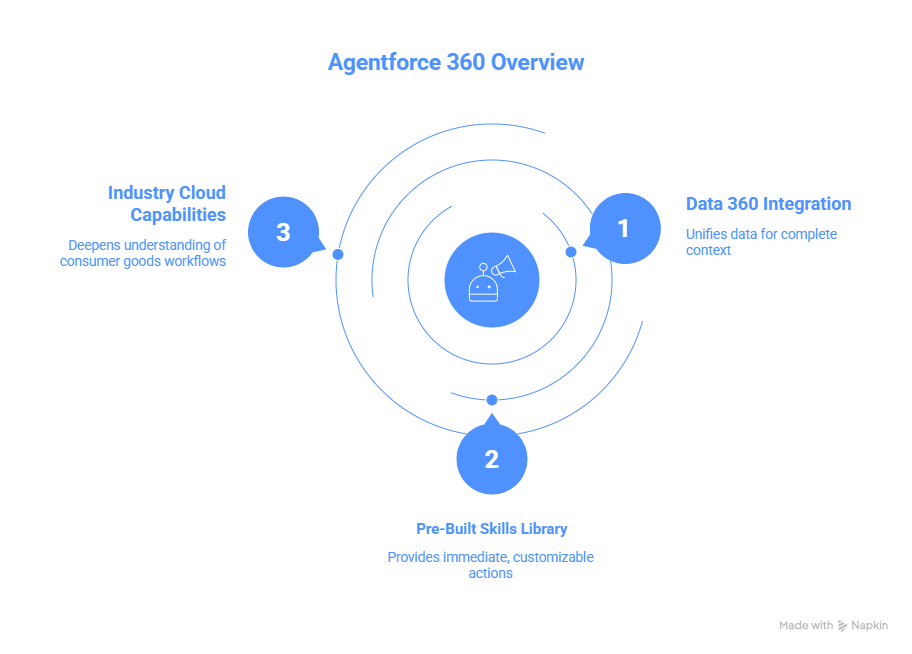
At its foundation, Agentforce 360 for consumer goods combines three essential elements:
- Data 360 Integration: The platform unifies data from Consumer Goods Cloud, ERPs, MDMs, and real-time interactions. This gives agents complete context for decision-making.
- Pre-Built Skills Library: Consumer goods-specific actions deploy immediately—account summaries, visit scheduling, sales agreement analysis, and maintenance alerts. Teams customize using low-code tools or build new skills from scratch.
- Industry Cloud Capabilities: Deep Consumer Goods Cloud integration means agents understand B2B and B2C workflows, promotional calendars, trade agreements, and field execution requirements.
The Einstein Trust Layer ensures governance, security, data privacy, and regulatory compliance across all agent operations.
| Feature | Traditional Solutions | Agentforce for Consumer Goods |
|---|---|---|
| Operation Mode | Reactive, human-triggered | Autonomous, proactive |
| Data Access | Siloed systems | Unified across all sources |
| Setup Time | Weeks to months | Days with pre-built skills |
| Customization | Code-heavy development | Low-code configuration |
How It Differs From Basic Chatbots
Traditional chatbots follow preprogrammed scripts and struggle with complex requests. When customers ask multi-step questions or need actions across multiple systems, these tools fall short. Salesforce’s Agentforce AI chatbot represents a fundamental leap forward in automation capabilities.
Agentforce agents use advanced reasoning powered by retrieval-augmented generation (RAG), machine learning, and natural language processing. They understand context, make decisions based on real-time data, and execute complete workflows without human intervention. This autonomy makes them suitable for complex consumer goods scenarios like managing trade promotions, analyzing account health, and coordinating field operations.
Four Practical Uses of Agentforce for Consumer Goods to Help Real Customers
Automating Customer Service and Account Management
Service teams deal with repetitive inquiries, consuming valuable time. Agentforce agents provide instant access to customer account information, transaction history, compliance insights, and top-selling products.
When a customer calls about a shipment, service reps no longer put callers on hold. The agent instantly surfaces revenue performance, visit history, compliance status, and suggests following actions like scheduling store audits or offering additional products based on account details.
SharkNinja uses Agentforce to deliver real-time answers across 36 product categories, matching product innovation with innovation in customer interactions. Agentforce also drives revenue through telesales by recommending products, highlighting promotions, generating personalized pitches, and processing orders—freeing inside sales reps to focus on relationship building.
Optimizing Field Team Visit Management
Field teams waste hours on manual scheduling, balancing driver availability, inventory levels, and store priorities. Agentforce automates this entirely.
When a customer requests a replacement shipment before a holiday weekend, the agent automatically schedules the visit, assigns the optimal driver based on route efficiency and inventory, confirms delivery time, and updates all systems.
This eliminates coordination delays and ensures timely delivery during critical sales periods. The automation extends beyond scheduling, providing reps with pre-visit briefings and generating post-visit summaries documenting outcomes and follow-up actions.
Enhancing Sales Performance Through Agreement Monitoring
Account managers struggle to catch performance deviations across portfolios. By the time they notice issues, revenue opportunities have vanished.
Agentforce agents continuously monitor sales agreements against actual performance. When accounts show lower-than-expected orders, agents alert reps, suggest actions like pitching additional products, draft follow-up emails, and create visit schedules. This transforms account management from reactive problem-solving to proactive revenue optimization.
RNDC, a wholesale alcohol distributor, uses this to help newer sales reps achieve compliance goals through natural language guidance based on their Salesforce data. Agentforce agents also function as virtual sales coaches, analyzing performance, providing real-time feedback, and delivering personalized training for new product launches.
Enabling Proactive Asset Maintenance
For brands selling appliances or equipment, reactive maintenance creates customer frustration and revenue loss. Agentforce agents monitor product health data and predict maintenance needs before failures occur.
A service rep can ask the agent to summarize the health status of a customer’s products. If maintenance is due, the agent automatically creates quotes, generates work orders, and drafts customer communications.
This shifts the relationship from break-fix to preventive care, improving satisfaction while creating new service revenue streams.
| Use Case | Manual Process Time | Agentforce Time | Efficiency Gain |
|---|---|---|---|
| Account Summary Generation | 15-20 minutes | <30 seconds | 95%+ reduction |
| Visit Scheduling | 30-45 minutes | <1 minute | 97%+ reduction |
| Agreement Deviation Analysis | 2-3 hours | Real-time alerts | 98%+ reduction |
| Maintenance Quote Creation | 20-30 minutes | <2 minutes | 93%+ reduction |
Now that we’ve covered how brands use these agents, let’s examine the broader role they play in transforming consumer goods operations.
What Is the Role of Agentforce for Consumer Goods?
Agentforce for Consumer Goods functions as a layer of digital labor that operates across every customer-facing and internal process. Rather than replacing human workers, these agents handle repetitive, data-intensive tasks that slow teams down.
Bridging Planning and Execution
Consumer goods companies operate in two modes: planning (forecasting, promotion design) and execution (field visits, order fulfillment, customer service). Historically, these existed in separate systems with manual handoffs.
Agentforce connects these workflows on a single platform. A planned promotion automatically triggers agents to schedule visits, alert reps to key accounts, and adjust inventory. This eliminates lag between strategic decisions and tactical action. The Salesforce implementation services required to connect these workflows demand a deep understanding of both technology and consumer goods processes.
Unifying B2B and B2C Operations
CPG brands serve wholesale distributors and direct consumers, requiring different processes and pricing structures typically managed separately. The platform harmonizes B2B and B2C data through the Consumer Goods Cloud data model.
Agents serve both a retail buyer placing wholesale orders and a consumer requesting replacement parts, accessing appropriate data and workflows without separate implementations.
Reducing Cost to Serve
Labor costs in consumer goods continue rising. Salesforce research shows desk workers spend 41% of their time on repetitive, low-value tasks. By delegating these to AI agents, companies reduce operational expenses while maintaining service quality.
Organizations looking to maximize efficiency gains should consider Salesforce managed services to ensure agents remain optimized as business needs evolve.
Improving Data Quality and Accessibility
Consumer goods organizations struggle with data scattered across ERPs, MDMs, PIMs, and legacy systems. Agentforce integrates these external systems while processing data in Data Cloud, creating a single source of truth accessible through natural language queries.
A sales rep can ask “Which accounts are at risk of churn?” and receive instant, data-backed answers instead of running complex reports.
| Data Challenge | Traditional Approach | Agentforce Solution |
|---|---|---|
| Siloed Systems | Manual data exports and imports | Real-time integration via Data Cloud |
| Complex Queries | Custom reports requiring IT support | Natural language questions with instant answers |
| Outdated Information | Batch updates (daily/weekly) | Real-time data synchronization |
| Limited Accessibility | Desktop-only access to full data | Mobile access to complete context |
Understanding how Salesforce Data Cloud consulting services can unify your data landscape is crucial for maximizing Agentforce effectiveness.
Marketing teams using Agentforce create campaigns that adapt in real-time based on customer behavior.
Predictive Product Development
AI agents analyze market trends, customer feedback, and sales data to identify product opportunities. This accelerates innovation cycles by surfacing insights that would take human analysts weeks to compile, achieving 25-40% faster time-to-market while reducing product failure risk through data-backed decisions.
| Future Capability | Impact on Operations | Timeline |
|---|---|---|
| Supply Chain AI | 30-50% error reduction | 2026-2027 |
| Sustainability Tracking | Automated compliance reporting | 2026 |
| Predictive Analytics | 80%+ accuracy in forecasting | 2025-2026 |
| Product Innovation AI | 25-40% faster launches | 2027-2028 |
These advances build on the foundation established by current Agentforce capabilities, creating an integrated ecosystem where AI supports every aspect of consumer goods operations.
Companies investing in Salesforce consulting services now position themselves to capitalize on these emerging capabilities as they become available.
What /is/ AgentForce? Does it /Work/?
by u/idealistintherealw in salesforce
Key Takeaways
- Agentforce for Consumer Goods delivers measurable ROI through automated workflows that reduce manual tasks by up to 95% in specific processes.
- Successful implementation requires clean, unified data across systems and clear process documentation before deploying agents.
- Pre-built skills accelerate deployment, but customization through low-code tools ensures agents match your specific business needs.
- Integration with Data Cloud is essential for real-time, contextual decision-making across sales, service, and field operations.
- The platform works best when paired with Consumer Goods Cloud and proper change management to drive user adoption.
Conclusion
Agentforce for Consumer Goods represents a fundamental shift in how CPG brands operate. By deploying autonomous AI agents across sales, service, and field execution, companies reduce costs, improve efficiency, and deliver better customer experiences.
Brands like SharkNinja, RNDC, and Saks are already seeing results, from 30% efficiency gains to 70% case resolution rates.
The key is starting with clear use cases, ensuring data quality, and choosing the right implementation partner.
If you’re ready to explore how Agentforce for consumer goods can transform your operations, connect with our Salesforce consulting team to discuss your specific needs and build a deployment roadmap.
FAQs
What Is Agentforce by Salesforce?
Agentforce is Salesforce’s autonomous AI platform that completes tasks, makes decisions, and takes action without human oversight. Unlike chatbots, it operates independently across text and voice channels.
Can Agentforce Work Without a Data Cloud?
Yes, but performance suffers. Without Data Cloud, agents lack real-time, unified customer data needed for accurate, contextual responses.
How Effective Is Salesforce Agentforce for AI-Powered Customer Support?
Companies report 70% autonomous resolution rates and 30%+ faster response times. Results depend on training data quality and system integration.
How Far Is Agentforce Being Used in Customer Projects?
Thousands of companies have deployed Agentforce since late 2024. Over 10,000 agents were built at Dreamforce 2024 across retail, financial services, healthcare, and consumer goods.
Real Benefits of Using Data Cloud and Agentforce?
Unified customer views, real-time data access, improved accuracy, automated cross-department workflows, and integrated analytics. Together, they create a scalable AI foundation.