
What Is Salesforce Agentforce?
Salesforce Agentforce is a suite of AI-powered autonomous agents built on advanced large language models (LLMs) that transform how businesses operate. Think of it as hiring a digital workforce that never sleeps, never takes a vacation, and never misses a follow-up.
At its core, Agentforce leverages four key components that work together:
- Atlas Reasoning Engine processes complex real estate data through Data Cloud, coordinating between topics (job categories) and actions (specific tasks) to fulfill user requests. It makes split-second decisions based on context and company guidelines.
- Agent Builder provides a low-code interface where real estate professionals can customize agents or build new ones using existing tools like Flows, Prompts, Apex, and MuleSoft APIs.
- Pre-built Agents include Service Agent for customer support, SDR Agent for sales prospecting, Sales Coach for training, and Campaign Optimizer for marketing strategy.
- Einstein Trust Layer ensures security and reliability with built-in safeguards that protect sensitive client information while maintaining audit trails.
Unlike basic automation that follows if-then rules, Agentforce agents understand natural language, maintain context across conversations, and handle unplanned exceptions. When a prospect asks about properties in a specific neighborhood, Agentforce doesn’t just search listings—it analyzes their browsing history, considers their budget, factors in recent market trends, and provides personalized recommendations.
Does Agentforce Belong to Salesforce?
Yes, Agentforce is built directly on the Salesforce platform, integrating seamlessly with Sales Cloud, Service Cloud, Marketing Cloud, and other Salesforce products. This native integration means real estate professionals get tailored support without juggling multiple disconnected systems.
The platform evolved from Einstein Copilot, which Salesforce unveiled as its next-generation AI offering. Marc Benioff, Salesforce CEO, positioned Agentforce as “the third wave of AI—advancing beyond copilots to highly accurate, low-hallucination intelligent agents that actively drive customer success.” This represents how Salesforce Agentforce is changing the game across industries.”
For real estate firms already using Salesforce, deploying Agentforce for real estate doesn’t require ripping out existing infrastructure. It layers intelligent automation on top of your current CRM setup, accessing the data you’ve already organized while adding autonomous capabilities that traditional CRM simply can’t match.
The conversation-based pricing starts at $2 per interaction, making it accessible for boutique brokerages and large commercial real estate firms alike. This pricing model means you pay for actual AI work completed, not just licensing seats that may go unused.
Benefits of Salesforce Agentforce for Real Estate
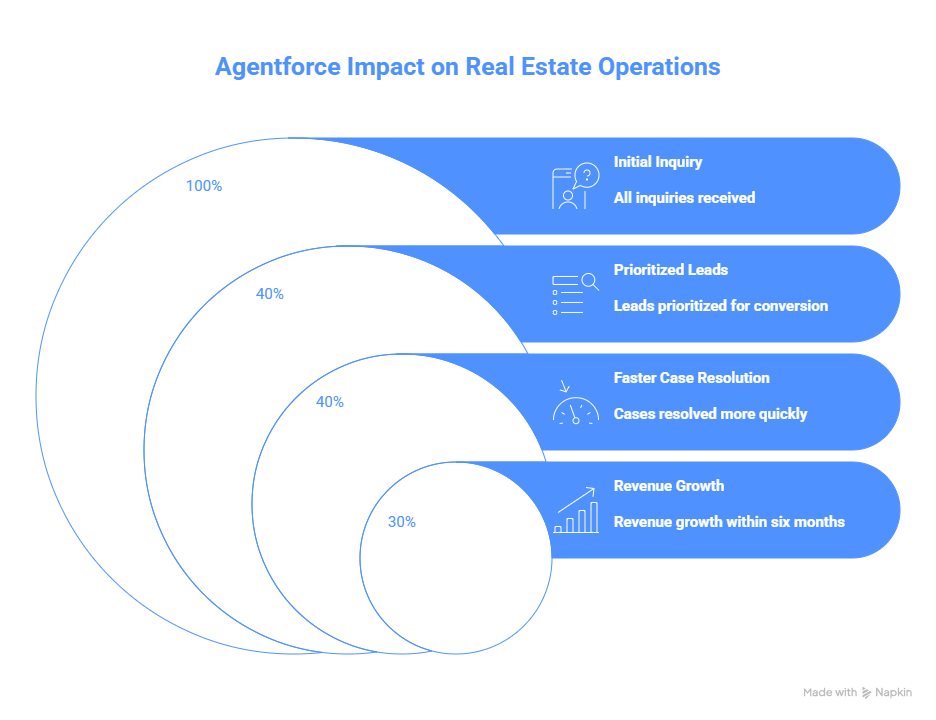
Real estate operates on thin margins where every hour counts. Agentforce delivers quantifiable operational improvements that directly impact your bottom line.
Always-On Client Engagement: According to NAR data, 43% of buyers now start their property search online. Agentforce ensures you’re there when they’re searching—at 2 AM on Sunday or during your busiest showing day. Prospects receive instant, contextual responses that feel human, not robotic.
Document Processing Speed: Real estate drowns in paperwork. Purchase agreements, disclosure forms, inspection reports, lease abstracts Agentforce processes these in minutes using optical character recognition and natural language processing. Tasks that consumed weeks of analyst time now happen automatically.
Intelligent Lead Prioritization: Not every inquiry deserves equal attention. Agentforce analyzes engagement patterns, financial indicators, and behavioral signals to score leads by conversion probability. Your team focuses on prospects most likely to close while Agentforce nurtures everyone else.
Portfolio Monitoring at Scale: For investment firms managing multiple properties, Agentforce monitors market conditions, identifies refinancing opportunities, flags lease expirations, and alerts teams to emerging risks all without manual oversight.
Marketing Personalization: Agentforce orchestrates multi-channel campaigns that adapt based on prospect behavior. If someone views waterfront properties three times, your next email showcases marina access, not golf course views.
Organizations implementing Agentforce typically see 40% faster case resolution, 50% reduction in manual tasks, and 1.3x revenue growth within six months. Companies like Wiley achieved over 40% increase in self-service efficiency and 213% ROI after deploying Service Cloud with Agentforce.
How Agentforce Works in Real Estate?
Understanding how Agentforce works at a technical level helps explain why it performs differently than previous automation attempts.
The system operates through a continuous reasoning loop. When a prospect submits a query, the Atlas Reasoning Engine analyzes available data sources—property listings, client history, market comparables, conversation context—then determines the appropriate action sequence.
For example, if a client asks, “Show me investment properties under $2M with strong rental yields in growing neighborhoods,” Agentforce doesn’t just search by price. It:
- Queries your property database for sub-$2M listings
- Analyzes historical rental data to calculate yields
- Cross-referencing demographic trends and development permits to identification of growth areas
- Checks the client’s risk tolerance from previous conversations
- Generates a curated list with investment projections
- Schedules follow-up based on client response patterns
This happens in seconds, delivering results that would take an analyst hours to compile manually.
The Data Cloud integration is crucial here. Agentforce doesn’t work in isolation—it taps into your entire Salesforce ecosystem, accessing structured CRM data alongside unstructured information like email threads, call transcripts, and property photos. This comprehensive data access enables genuinely contextual responses.
Security remains paramount through the Einstein Trust Layer. Every interaction follows role-based permissions, maintains audit logs, and operates within compliance boundaries you’ve defined. Client data never leaks between agents or organizations.

Agentforce for Real Estate: Use Cases
Real-world applications demonstrate where Agentforce delivers the highest impact. These aren’t theoretical possibilities—they’re implementations happening right now across residential and commercial real estate.
Agentforce Use Case #1: Closing Deals Even When You’re Offline
Your best prospects don’t wait for business hours. A serious buyer researching properties at midnight expects immediate answers, not a “we’ll get back to you Monday” autoresponder.
Agentforce handles initial contact, answers detailed questions about specific properties, schedules showings based on your calendar availability, and routes qualified leads to the appropriate team member. When you arrive at the office, you’re walking into scheduled appointments with pre-qualified prospects, not sorting through overnight inquiries.
One brokerage using Agentforce reported handling 3x more after-hours inquiries without adding staff. Their close rate on weekend leads increased 60% because prospects received immediate, helpful responses instead of generic automated messages.
Agentforce Use Case #2: Managing Portfolios More Effectively
Investment firms deploying Agentforce for commercial real estate use customized agents that monitor portfolio performance across multiple properties. These agents track:
- Lease expiration timelines across your entire portfolio
- Market rent comparisons signaling repricing opportunities
- Tenant payment patterns predicting delinquency risk
- Comparable sales data affecting property valuations
- Interest rate movements creating refinancing windows
When rates dropped recently, one firm’s Agentforce implementation flagged refinancing opportunities across three properties before their analysts noticed the trend. This proactive monitoring saved them hundreds of thousands in interest costs.
Agentforce Use Case #3: Faster and More Focused Marketing
Real estate marketing requires constant content creation—property descriptions, email campaigns, social posts, market updates. Agentforce generates this content by analyzing property features, neighborhood data, and prospect preferences.
The system doesn’t just write generic descriptions. It tailors messaging based on who’s receiving it. A family searching for schools sees education rankings and playground proximity. An investor receives cap rate analysis and tenant demand data for the exact same property.
Marketing teams report creating campaigns 40% faster while seeing higher engagement rates because every message matches recipient interests. Customizing just three core workflows typically saves real estate firms up to 40 hours weekly.
Agentforce Use Case #4: Automatically Summarizing Listings, Deals, and Client Interactions
Real estate professionals handle so much information that critical details get lost. Agentforce automatically summarizes:
- Listing presentations into key features and competitive advantages
- Complex deals into decision points and next steps
- Client meetings into action items and follow-up requirements
- Market research into actionable investment insights
After a property showing, your agent dictates observations into their phone. Agentforce transcribes the notes, updates the CRM, creates follow-up tasks, and drafts a personalized client email—all before they reach their car.
Agentforce Use Case #5: Analyzing Lead Behavior and Engagement
Traditional lead scoring looks at surface metrics: email opens, website visits, form submissions. Agentforce analyzes behavioral patterns that signal serious intent.
It recognizes when someone views the same property multiple times, researches school districts, checks mortgage calculators, and views similar listings in the same neighborhood. These patterns indicate readiness to make an offer, not just casual browsing.
The system automatically adjusts lead scores in real-time, ensuring your follow-up intensity matches prospect readiness. High-intent leads get immediate phone calls. Low-engagement contacts receive nurture campaigns until behavior signals renewed interest.
Agentforce Use Case #6: Automating Marketing and Client Communication Intelligently
Every transaction requires dozens of communications: appointment confirmations, document requests, status updates, and closing reminders. Agentforce automates these touchpoints while maintaining personalization.
The system knows when a client prefers text over email, what time of day they typically respond, and which properties match their search criteria. Communications feel individually crafted because they are—just created by AI analyzing individual preferences rather than a human manually customizing each message.
One firm automated 70% of routine communications, freeing agents to spend time on complex negotiations and relationship building instead of typing follow-up emails.
More Examples of AI Agents Customization on Top of Agentforce
Beyond pre-built agents, real estate firms create specialized solutions using Agent Builder. Examples include:
- Property Valuation Agent: Analyzes comparable sales, adjusts for unique features, factors in market trends, and generates automated valuation models (AVMs) with confidence scores.
- Compliance Verification Agent: Reviews transaction documents against federal and local regulations, flagging potential disclosure violations before they become problems.
- Showing Coordinator Agent: Manages scheduling across multiple agents and properties, handling conflicts, sending reminders, and gathering post-showing feedback.
- Investment Analysis Agent: Calculates IRR, cap rates, cash-on-cash returns, and other investment metrics, producing formatted reports for stakeholders.
The low-code Agent Builder makes these customizations accessible to business users, not just developers. You define what the agent should do, connect it to your data, and deploy it across your organization.
How Agentforce Transforms Commercial Real Estate Operations
Commercial real estate deals with longer sales cycles, more complex transactions, and higher stakes than residential. Agentforce for commercial real estate addresses these specific challenges through specialized agent configurations.
Deal Screening Automation: CRE brokers receive countless inquiries, most not worth pursuing. Agentforce agents assess prospect qualification by analyzing:
- Company financials and creditworthiness
- Space requirements against available inventory
- Budget alignment with market rates
- Decision-maker access and timeline urgency
Qualified prospects get immediate attention. Everyone else enters nurture campaigns until circumstances change.
- Offering Memorandum Generation: Creating detailed offering memorandums consumed days of analyst time. Agentforce pulls property data, financial performance, market analysis, and comparable transactions, then assembles professional-grade presentations automatically.
- Tenant Communication Portals: Property managers deploy Agentforce through Experience Cloud portals where tenants submit maintenance requests, make payments, and access documents. The system routes urgent issues to maintenance teams while handling routine inquiries automatically.
- Market Intelligence Gathering: Commercial agents need constant market awareness. Agentforce monitors news sources, public records, and industry publications, alerting teams to:
- Major tenant expansions or contractions
- Development permit filings in target areas
- Changes in zoning regulations affecting property values
- Emerging submarkets showing growth potential
How Commercial Real Estate Firms Can Use Different Types of AI Agents
Commercial real estate encompasses diverse specializations, each benefiting from tailored agent configurations:
- Sales/Tenant Representative Brokers centralize client requirement tracking, streamline property tour coordination, and optimize deal pipeline management through agents that match tenant needs with available spaces across their entire market.
- Landlord Representatives systematize lease portfolio oversight, automate tenant retention campaigns, and maintain comprehensive relationship intelligence that flags renewal risks months in advance.
- Investment Sales Brokers implement predictive lead scoring algorithms that identify serious buyers, orchestrate multi-channel marketing campaigns targeting specific investor profiles, and facilitate complex transaction coordination across multiple stakeholders.
- Property Managers deploy service agents that handle maintenance requests, process rent payments, coordinate vendor scheduling, and escalate only issues requiring human judgment.
Each specialization configures Agentforce differently, but all benefit from the same foundational capabilities: natural language understanding, contextual decision-making, and autonomous task execution.
Agentforce Agents vs. Einstein Bots: Which Option Works Best for Real Estate?
Many real estate firms already use Einstein Bots for basic customer service. Understanding how Agentforce differs helps you decide whether upgrading makes sense.
- Autonomy Level: Einstein Bots follow predefined dialog flows. If a question falls outside programmed scenarios, the bot gets stuck. Agentforce agents think through problems, handling unexpected queries by reasoning through available data and previous interactions.
- Scope of Operation: Einstein Bots live primarily in customer service contexts—answering FAQs, creating support tickets, providing basic information. Agentforce works across sales, marketing, operations, and service, executing tasks in any business function.
- Customization Approach: Einstein Bots require developers to script every possible conversation path. Agentforce uses natural language instructions where you describe what the agent should accomplish, and it figures out how to do it.
- Context Understanding: Einstein Bots process one query at a time without maintaining conversation context. Agentforce remembers previous interactions, understands follow-up questions, and maintains context across multiple conversation turns.
- Learning Capability: Einstein Bots remain static until developers update dialog flows. Agentforce improves through usage, adapting its responses based on successful interactions and feedback.
Agentforce vs. Einstein Chat Bot
byu/Cool-Half3676 insalesforce
Comparing Agentforce Agents and Einstein Bots
| Feature | Agentforce Agents | Einstein Bots |
|---|---|---|
| Decision-Making | Autonomous, context-aware | Rule-based, predefined paths |
| Use Cases | Complex workflows across departments | Customer service FAQs |
| Setup Complexity | Low-code with natural language | Requires dialog flow scripting |
| Adaptation | Learns from interactions | Static until manually updated |
| Data Sources | Structured and unstructured data | Primarily structured CRM data |
| Multi-Turn Conversations | Maintains full context | Limited context between queries |
| Integration Scope | Enterprise-wide systems | Primarily Salesforce Service Cloud |
| Pricing Model | Per conversation ($2/interaction) | User license-based |
Our Verdict: For most real estate operations, Agentforce’s sophisticated understanding and contextual awareness make it the preferred choice for elevating client service and streamlining complex transactions. Einstein Bots work well for simple FAQ handling, but serious operational transformation requires Agentforce capabilities.
For firms handling high-value transactions where context matters enormously—commercial leases, investment sales, property management—Agentforce’s ability to understand nuance and make judgment calls delivers significantly better outcomes.
Key Challenges of Implementing Agentforce in Real Estate
Despite compelling benefits, Agentforce implementations face predictable obstacles. Anticipating these challenges improves your deployment success rate.
Data Quality and Integration Challenges
AI systems are only as good as the data feeding them. Real estate firms often maintain fragmented, inconsistent, and outdated data across multiple systems—property management platforms, email clients, spreadsheets, and legacy CRMs.
The Business Research Company reports the AI in real estate market will grow from $222.65 billion in 2024 to $975.24 billion in 2029, driven by firms that solve data quality issues. Dirty data produces unreliable AI outputs that erode team confidence in the system.
Solutions: Begin with a 30-day data cleanse focusing on your top 20% most active clients and highest-value properties. Standardize property data formats, remove duplicate contacts, and verify critical fields before deploying Agentforce. Clean CRM data is non-negotiable—your AI strategy is only as good as your data.
Partner with Salesforce implementation specialists who understand real estate data structures and can architect proper integration points between Agentforce and your existing systems.
Resistance to Change and Adoption
Agents who’ve worked a certain way for 20 years don’t embrace AI automatically. Common concerns include job security fears, skepticism about AI reliability, and simple preference for familiar processes.
CBRE’s AI implementation experience revealed that transparent communication about AI’s impacts builds trust and mitigates fears. They created an AI Champions Network encouraging employees to use AI in daily tasks and providing support for understanding and leveraging tools effectively.
Solutions: Frame Agentforce as augmentation, not replacement. Show concrete examples where AI handles tedious work—data entry, appointment scheduling, document summarization—freeing agents for high-value activities like negotiation and relationship building.
Start with voluntary adoption among tech-forward team members. Early success stories from peers prove more persuasive than executive mandates. Provide hands-on training showing exactly how Agentforce makes their jobs easier, not harder.
Managing Costs and ROI Expectations
AI implementation involves upfront costs for platform licensing, integration work, data migration, and training. Financial stakeholders want clear ROI projections before approving budgets.
Organizations implementing Agentforce typically achieve 40% faster case resolution, 50% reduction in manual tasks, and positive ROI within 3-4 months. However, these outcomes require proper implementation and change management—not just turning on the software.
Solutions: Start with high-impact, low-risk pilot projects that demonstrate value quickly. Deal screening automation provides immediate ROI through time savings while building team confidence in AI capabilities.
Calculate current costs of manual processes—agent hours spent on routine tasks, deals lost to slow follow-up, opportunities missed due to information gaps. Compare these against Agentforce pricing to build business cases executives understand.
Track quantifiable metrics: response time improvements, lead conversion rate changes, agent capacity increases, and client satisfaction scores. Hard numbers overcome skepticism faster than theoretical benefits.
Security and Compliance Issues
Real estate transactions involve sensitive financial information, personal identification details, and confidential business negotiations. Security breaches create legal liability and reputational damage.
Agentforce addresses this through the Einstein Trust Layer with role-based permissions, audit trails, and compliance frameworks. However, firms must still configure these security controls properly and maintain governance over AI agent access.
Solutions: Work with certified Salesforce consultants who understand real estate compliance requirements—Fair Housing Act, GDPR, CCPA, state-specific disclosure rules. They’ll implement security configurations matching your regulatory obligations.
Establish AI governance policies defining what data agents can access, what actions they can take autonomously, and what decisions require human approval. Document these policies and train staff on proper AI usage.
Conduct regular security audits ensuring Agentforce implementations maintain proper data isolation and access controls as your organization evolves.
Integration with Current Workflows
Real estate firms run on established processes that reflect years of refinement. Forcing Agentforce into incompatible workflows creates friction rather than efficiency.
Many firms try full-scale implementations affecting every department simultaneously. This overwhelms teams and creates support burdens that IT can’t handle, leading to abandoned projects.
Solutions: Map existing workflows before designing AI interventions. Identify high-frequency, rule-based processes that consume disproportionate time—these make ideal automation candidates.
Implement Agentforce incrementally, starting with one high-impact workflow. Customize that implementation thoroughly, gather feedback, refine the approach, then expand to additional processes. Phased rollouts prevent overwhelming your organization while building momentum through early wins.
Don’t reinvent workflows unnecessarily. Start with Agentforce’s standard actions, then layer custom components addressing your unique requirements. Pre-built functionality handles 80% of use cases—focus customization on the 20% driving competitive advantage.
Building and Maintaining a Knowledge Base
Agentforce agents rely on knowledge bases to answer questions accurately. Real estate knowledge bases must cover property details, market conditions, regulatory requirements, company policies, and transaction procedures.
Building comprehensive knowledge bases takes significant effort, and maintaining them as information changes requires ongoing commitment.
Solutions: Begin with frequently asked questions your team already answers repeatedly. Convert these into structured knowledge articles that Agentforce can reference.
Use existing content—training materials, policy documents, property listings, market reports—as your knowledge base foundation rather than creating everything from scratch.
Assign knowledge base maintenance responsibility clearly. Without ownership, information becomes outdated quickly, degrading AI response quality.
Implement feedback loops where agents flag incorrect AI responses, triggering knowledge base updates. This continuous improvement prevents accuracy drift over time.
How Folio3 Can Be Your AI Strategic Partner?
Implementing Agentforce successfully requires more than purchasing licenses. You need partners who understand both Salesforce architecture and real estate operations.
Folio3 brings 15+ years of CRM expertise and holds multiple Agentforce implementation certifications.
We’ve delivered 1000+ successful Salesforce projects across industries, including healthcare, and HR services with specialized experience in real estate workflows.
What Sets Our Approach Apart:
- Industry-Specific Configuration: We don’t deploy generic Agentforce setups. Our consultants configure agents specifically for real estate use cases—lead qualification, property matching, transaction management, and portfolio monitoring—based on how your firm actually operates.
- Data Architecture Expertise: Our Salesforce customization services include data migration, cleansing, and integration work that establishes the clean data foundation Agentforce requires. We connect your property management systems, marketing platforms, and financial tools into unified data flows.
- Change Management Support: Technology adoption depends on user buy-in. We provide role-specific training, ongoing support, and adoption monitoring ensuring your team actually uses Agentforce instead of working around it.
- Continuous Optimization: AI implementations improve over time through usage analysis and refinement. Our managed services include regular performance reviews, agent optimization, and expansion planning as your needs evolve.
- Security and Compliance: We implement governance frameworks ensuring your Agentforce deployment meets real estate regulatory requirements while protecting sensitive client data.
- ROI Accountability: We establish clear success metrics upfront—response time targets, conversion rate goals, efficiency improvements—then track progress against these benchmarks throughout implementation.
Organizations working with certified implementation partners achieve ROI 16x faster than firms attempting self-implementation. Our Salesforce Agentforce consulting partners accelerate your path to value while avoiding costly missteps that delay results.
Whether you’re a boutique brokerage exploring AI possibilities or a national firm scaling Agentforce across multiple markets, Folio3 delivers implementations that drive measurable business outcomes.
FAQs
What is Salesforce Agentforce and how does it work in real estate?
Agentforce is an autonomous AI platform using large language models and the Atlas Reasoning Engine to execute real estate tasks. It handles client inquiries, processes documents, analyzes leads, manages portfolios, and automates marketing without human intervention.
How is Agentforce different from Einstein Bots?
Einstein Bots follow predefined dialog flows for simple tasks. Agentforce operates autonomously across all business functions, understands context, handles multi-turn conversations, learns from interactions, and manages complex workflows.
Can Agentforce integrate with existing real estate software systems?
Yes. Agentforce integrates with property management platforms, marketing automation tools, financial systems, and enterprise applications through Salesforce’s integration capabilities without requiring infrastructure replacement.
What are the main implementation challenges for Agentforce in real estate?
Data quality issues, change management resistance, integration complexity with legacy systems, security and compliance requirements, upfront costs, and maintaining accurate knowledge bases. Implementation partners reduce these risks.
How much does Agentforce cost for real estate firms?
Conversation-based pricing starts at $2 per interaction. Total costs depend on interaction volume, customization, integration needs, and support. Most firms achieve positive ROI within 3-4 months.
What ROI can real estate firms expect from Agentforce implementation?
40% faster case resolution, 50% reduction in manual tasks, 1.3x revenue growth within six months, and positive ROI within 3-4 months. Results vary based on implementation quality and data readiness.
Is Agentforce suitable for commercial real estate firms?
Yes. Agentforce handles deal screening, offering memorandum generation, tenant communications, lease portfolio management, and market intelligence. Investment sales brokers, landlord reps, tenant reps, and property managers benefit from specialized configurations.