


An order management system (OMS) is a software solution that automates and streamlines the order fulfillment process, enabling businesses to process orders quickly and accurately. Salesforce Commerce Cloud is a leading order management systems platform that helps companies manage orders, inventory, and customer data in a single, integrated system.
This blog will explore how Salesforce Commerce Cloud can help you streamline your order management processes, reduce costs, and improve customer satisfaction. Whether you’re a small business looking to improve your order management capabilities or a large enterprise seeking to optimize your OMS with Salesforce Commerce Cloud implementation, this blog is for you.
Why Order Management Matters: By The Numbers
- Order volume growth: Retailers using modern OMS see 30–50% increases in order processing capacity without proportional cost increases.
- Return rate impact: Self-service returns portals reduce return processing time by 60%, lowering operational costs.
- BOPIS adoption: Retail brands offering Buy Online, Pick Up In-Store see 2–3x higher conversion rates than delivery-only models.
- Omnichannel efficiency: Unified order management reduces order-to-fulfillment time by 40%, improving customer satisfaction scores.
Salesforce OMS is the operational backbone that makes these metrics possible. This blog explores how Commerce Cloud enables these order management benefits for your business.
What Is Salesforce Order Management Systems?
It is a system that manages the end-to-end order lifecycle for all business sizes. B2C Commerce gives companies the tools to streamline order placement, processing, fulfillment, and delivery. Other key features of Salesforce order management systems include:
- Order capture
- Order fulfillment
- Inventory management
- Integration capabilities
- Customer service
- Reporting and analytics
- Customization and scalability
The Salesforce order management system is essential in helping businesses streamline various facets of the order process. As you read ahead, you will continue to learn more about it.
Benefits of Salesforce Order Management Systems
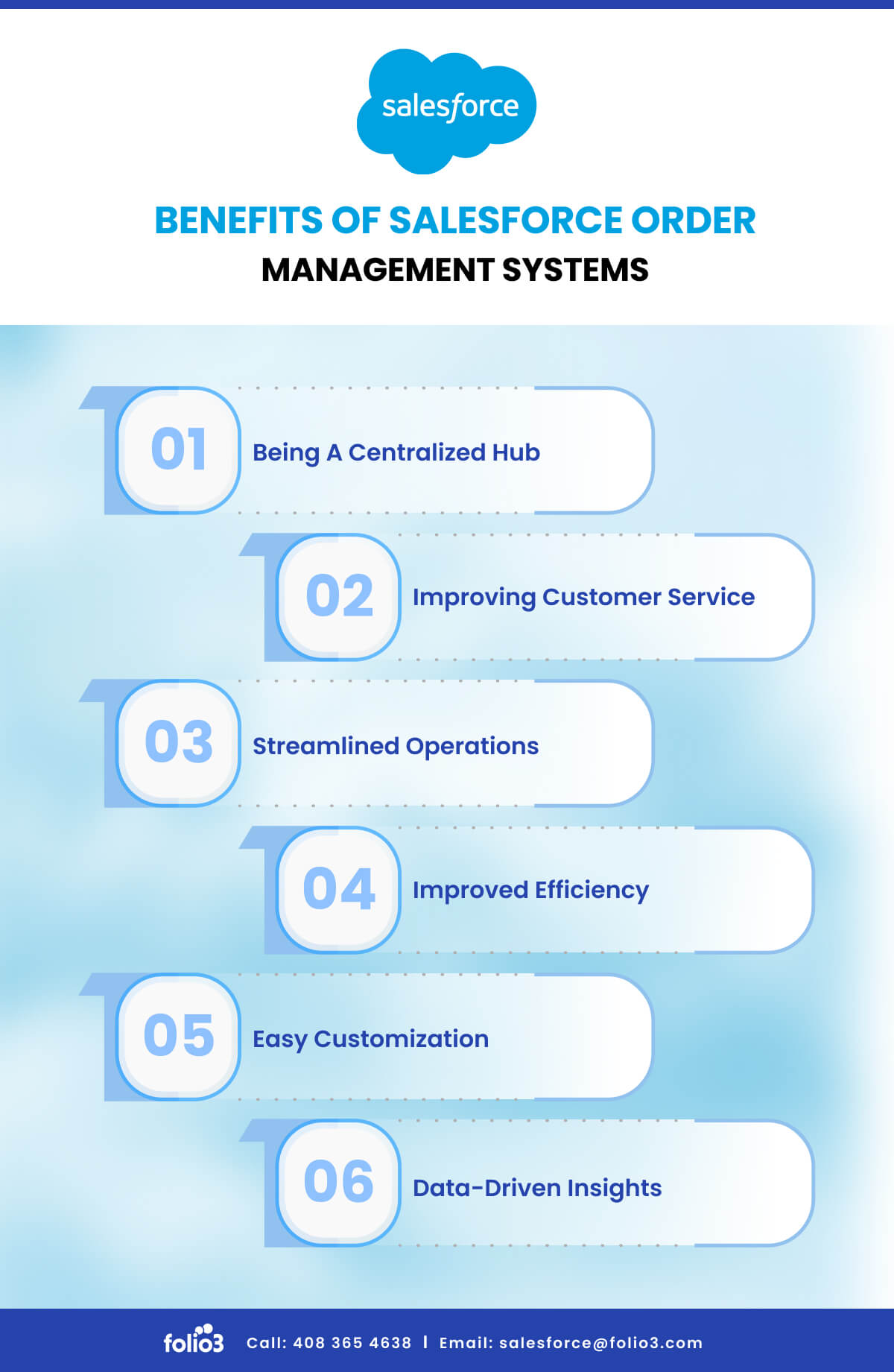
The Salesforce order management system is an essential tool for all businesses. Its benefits include:
Being A Centralized Hub
Salesforce order management systems act as a single location to manage different aspects of the order cycle. They manage order capture, fulfillment, logistics, and even after-sales support. Salesforce commerce cloud optimization and subsequent Salesforce commerce cloud migration further improve this.
Improving Customer Service
It allows customers to track orders in real-time and access other self-service options. Salesforce order management systems’ convenience and transparency translate to improved customer satisfaction scores.
Streamlined Operations
Your Salesforce order management system integrates with other Salesforce customer 360 products, such as B2C commerce, B2B commerce, and the Salesforce service cloud. The result eliminates data silos, and automated workflows align with streamlined order processing and fulfillment. Folio3’s integration services ensure your OMS connects seamlessly with existing ERP, CRM, and inventory systems.
Improved Efficiency
Centralized order data and automated tasks help the SF OMS reduce manual work and improve various facets of your business. With more work done in less time, business efficiency improves significantly.
Easy Customization
Salesforce uses a ‘clicks-not-code’ approach that allows businesses to create customized workflows and functions tailored to their specific needs. This creates a truly unique experience for each business based on what they want and need. However, complex custom logic often requires Salesforce development services or automation services from experienced architects. Folio3’s certified Commerce Cloud developers can handle bespoke OMS workflows that scale.
Data-Driven Insights
Like other Salesforce products, the OMS provides businesses essential data and subsequent insights about the order fulfillment process. The data can be used to identify performance bottlenecks, improve operational efficiency, and make more informed business decisions.
Why Is an Order Management System Crucial for a Successful Business?
Using an OMS is vital to businesses for a variety of reasons. They are crucial to the success of companies for a variety of companies, including:
- Improved accuracy and reduced errors
- Better inventory control
- Improved customer satisfaction
- Streamlined operations
- Improved decision making
- Scalability and growth
Having the SF OMS in your corner gives you an edge over those that don’t. It improves various aspects of the order fulfillment process, allowing your business to operate effortlessly.
With Salesforce order management systems, you get some of the best in the industry to work with.
Why Use Salesforce Order Management Systems?
There are several order management systems to pick from. However, the Salesforce order management system offers unique benefits that set it apart from the rest:
Integration With the Salesforce Ecosystem
Several businesses already use various Salesforce products (B2C commerce, B2B commerce, Service Cloud). The order management system fits right into the Salesforce ecosystem, eliminating the need for complex third-party integrations and ensuring all customer data is in one place. Leveraging Salesforce commerce cloud development shows how well all services integrate with each other.
Scalability For Business Growth
Salesforce systems are well-known and documented for their ability to manage large workloads. The Salesforce management system is the right choice for businesses that have forecasted rapid growth.
If you’re a business looking to grow, consider speaking with Salesforce Commerce Cloud consultants to better understand the products and offerings.
Ease Of Use and Customization
We mentioned the Salesforce ‘click-not-code’ approach, which prioritizes customization and user intuitiveness. Understanding the difference between B2B and B2C commerce workflows helps you configure OMS for your unique business model.
Customer-Centric Focus
The SF OMS considers customer experience. It offers real-time order tracking, returns management, and self-service options, all of which contribute to significantly improved customer satisfaction. The SF OMS helps keep customers happy, which is the best way to improve your business.
Factors to Consider While Choosing Order Management Systems
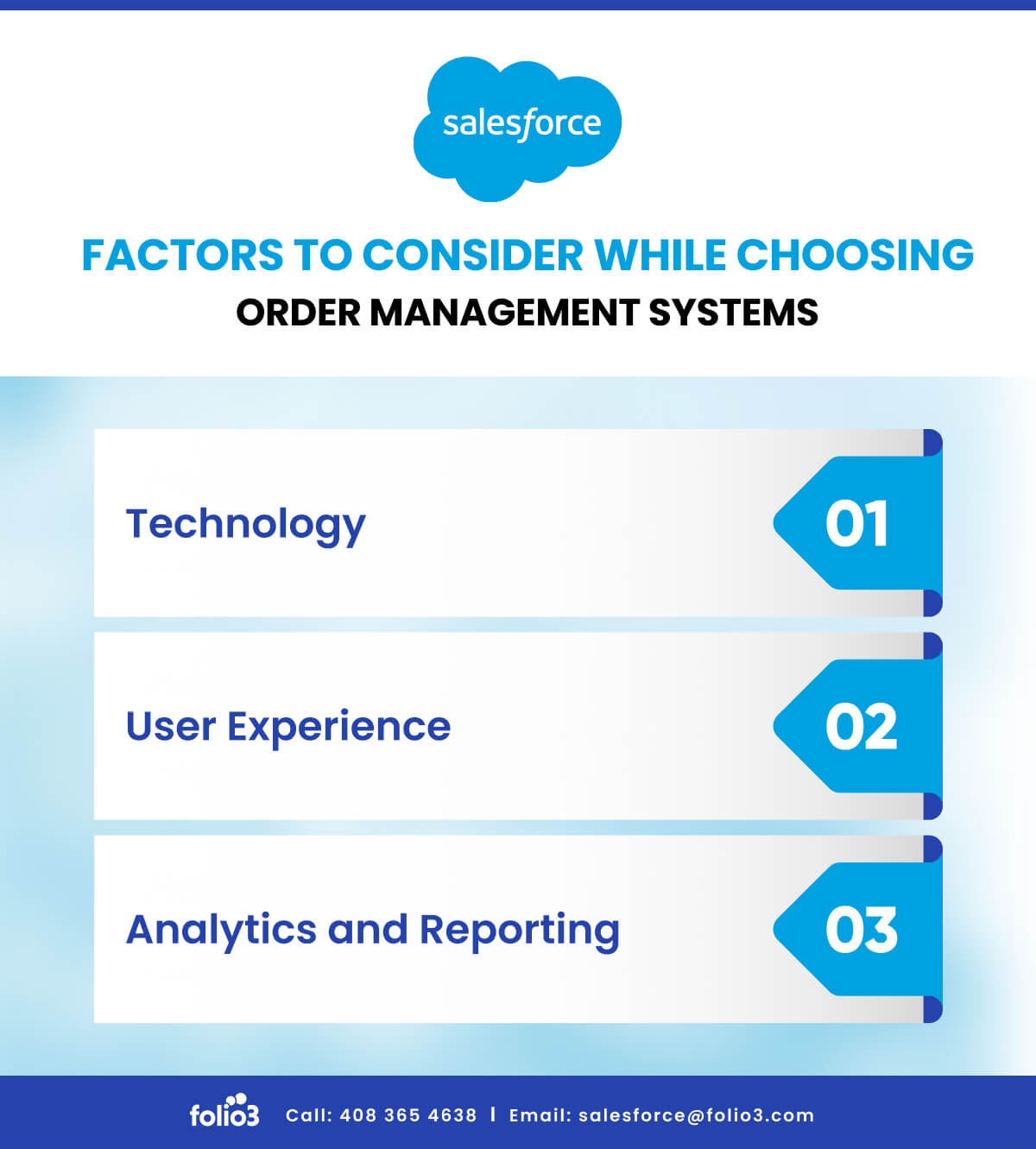
Choosing the right order management system requires considering several factors, including technology, user experience, and reporting and analytics.
Technology
When considering technology, keep the following in mind:
- Scalability: Can your OMS handle the current order volume and progressively grow with your business?
- Integrations: Does it integrate seamlessly with your ERP, CRM, and warehouse management systems? A seamless integration guarantees smoother data flow and eliminates data entry.
- Security: Do your preferred OMS have robust and reliable security controls? Protecting business and customer data at all times is imperative. Check whether your OMS has access controls, encryption, and a disaster recovery plan.
- Deployment: Do the OMS come with an on-premises, cloud-based, or hybrid deployment? Cloud-based deployments are the best because they are easier to implement and maintain. On-premises deployments give users more control over data security. A hybrid deployment leverages both features.
User Experience
For a quality user experience, look for this:
- Ease of use. Check whether the OMS is intuitive and user-friendly. Additionally, can employees learn how to operate and navigate it without much effort?
- Customized workflows. Do your preferred OMS let you create personalized workflows matching your business’s needs and processes?
- Mobile access. Look into whether the OMS comes with mobile access. This is particularly helpful for warehouse staff and sales reps who need to manage orders on the go.
Analytics and Reporting
For the best OMS analytics and reporting, here is what to look for:
- Reporting features. Check whether the OMS has different reports or dashboards to help track the order fulfillment process. Do these reports show order processing times, shipping costs, inventory levels, customer returns, and more?
- Data visualization. Do your OMS make visualizing data with charts, graphs, and other media easier? These tools help you identify patterns and trends in your data.
- Real-time insights. Your OMS should offer real-time insights during the order process to identify or address any issues that may arise.
What Core Components Make up the Salesforce Order Management Solution?
1. Salesforce Order Management Data Model
The data model is the foundation of Salesforce OMS. It defines how orders, fulfillments, returns, and related data are structured and stored, aligning with broader Salesforce platform capabilities. Key objects include:
- Order: Immutable record of the original customer purchase.
- Order Summary: Mutable record tracking the current order state.
- Fulfillment Order: Specifies which items ship from which fulfillment location.
- Order Item Summary: Individual line items and their fulfillment status.
- Return Order: Captures returned items and refund details.
This structure ensures data integrity while allowing order modifications through Order Summaries.
2. Salesforce Order Management Workflows
Workflows automate the end-to-end order lifecycle. They execute in response to events such as order placement in Commerce Cloud, payment authorization completion, fulfillment center shipment confirmation, and return requests from customers.
Salesforce provides sample workflows for common scenarios (standard fulfillment, split shipments, backorders, exchanges, fraud checks). Businesses customize these flows using the Flow Builder to create order automation matching their unique processes.
3. Flow Core Actions for Order Management
These pre-built actions reduce development time. Common actions include Create Fulfillment Order, Fulfill Order Item, Create Return Order, Update Payment, and Create Invoice. These actions can be chained together to build complex multi-step workflows without custom code.
4. Lightning Web Components for Order Management
LWCs are reusable, customizable UI components for order management screens. Examples include Order Lookup Component, Fulfillment Component, Returns Portal Component, and Order Summary Component. Teams without extensive coding experience can customize LWCs to reflect their brand and business processes.
5. Native Integration with Salesforce Ecosystem
Salesforce OMS is pre-built to integrate with Commerce Cloud (orders flow directly from storefront to OMS), Service Cloud (support agents view orders and process returns), Sales Cloud (renewal teams access order history), and custom systems via REST APIs and middleware like MuleSoft. This native integration eliminates data silos.
Understanding Order vs. Order Summary in Salesforce OMS
When implementing Salesforce Order Management, understanding the difference between Order and Order Summary records is critical for technical teams and architects.
Order
An Order record represents the immutable customer intent at the moment of purchase. Once an order is activated in Salesforce OMS, the Order record cannot be modified. It serves as the historical record of what the customer originally ordered. Order records are created from Commerce Cloud orders and remain unchanged, even if the customer later modifies their order.
Order Summary
An Order Summary is the working, mutable record of the current state of the order. This is what your fulfillment, service, and operations teams interact with daily. The Order Summary reflects all changes: fulfillment updates, partial shipments, returns, exchanges, cancellations, and refunds. When a customer requests a change, the Order Summary is updated, not the original Order record.
Why This Matters: By separating immutable (Order) from mutable (Order Summary) records, Salesforce provides a complete audit trail while allowing flexible order modifications. This design prevents data corruption and ensures compliance reporting remains accurate.
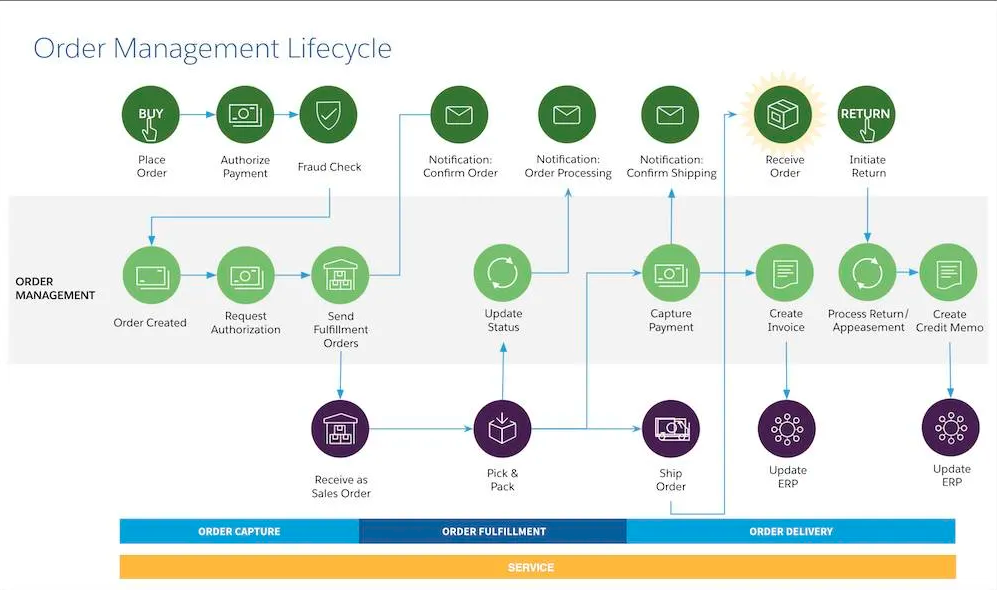
Salesforce Order Management Lifecycle
A typical order flows through distinct stages in Salesforce OMS. Understanding this journey helps teams optimize at each touchpoint.
1. Order Capture
Orders arrive from your storefront, mobile app, marketplace, or POS system. Salesforce consolidates all sources into a single dashboard, eliminating channel silos. Your order data is validated and prepared for the next stage.
2. Order Processing & Routing
A rules-based engine evaluates inventory availability, fulfillment location proximity, cost, and delivery speed. The system automatically routes orders to the optimal fulfillment center, warehouse, or store. Business rules you define determine priority: fastest shipping, lowest cost, or customer preference.
3. Fulfillment & Shipping
Once routed, the system creates fulfillment orders and sends them to your warehouse or fulfillment partner. Salesforce integrates with carriers (FedEx, UPS, DHL) to generate shipping labels and tracking numbers. Customers receive automated shipping notifications with real-time tracking.
4. Returns & Cancellations
Customers can request returns or order cancellations through a self-service portal. Salesforce automatically adjusts inventory, recalculates order totals, and processes refunds or credits. Return status flows back to customers in real-time.
5. Post-Delivery
Automated emails confirm delivery and invite customer feedback. This stage strengthens the post-purchase relationship and captures data for future personalization.
Salesforce OMS Use Cases Across Industries
Salesforce Order Management adapts to diverse business models and industries. Here’s how different companies leverage it:
Retail & Omnichannel
Retailers operating online, in-store, and via marketplaces use Salesforce OMS to unify orders across all channels. Omnichannel fulfillment strategies enable real-time inventory updates, preventing overselling while routing orders to the closest fulfillment location. Buy Online, Pick Up In-Store (BOPIS) and curbside pickup options increase conversion and customer convenience.
B2B & Wholesale
B2B commerce workflows with bulk orders, scheduled deliveries, and Net-30 invoicing use Salesforce OMS to manage complex fulfillment. The system supports multi-level approvals, purchase order matching, and invoice-based payment processes distinct from B2C operations.
Fashion & Apparel
Fashion retailers manage high SKU counts, frequent returns due to fit issues, and seasonal demand spikes. Salesforce OMS automates inventory allocation across sizes, colors, and locations, and streamlines the return-for-exchange workflow to keep inventory fresh.
Global & Cross-Border
Companies selling internationally use Salesforce OMS to manage multi-currency orders and cross-border tax compliance. The system auto-calculates duties based on destination, reducing manual overhead for regional shipping and customs documentation.
D2C (Direct-to-Consumer)
D2C brands use Salesforce OMS to track customer lifetime value and order history, enabling personalized post-purchase communication and loyalty rewards tied to order data.
Key Salesforce OMS Terminology
- Order Orchestration: Intelligent routing of orders to optimal fulfillment locations based on inventory, cost, and speed.
- Distributed Order Management (DOM): The process of automatically routing individual orders across multiple warehouses or fulfillment centers to minimize costs and delivery time.
- Order Routing Rules: Business logic that determines which fulfillment center receives an order based on criteria like proximity, inventory levels, and cost.
- Fulfillment Order: A child record created from an Order Summary that contains the items to be fulfilled from a specific location.
- Order Summary: The mutable record representing the current state of an order, including all changes, fulfillments, returns, and refunds.
- Omnichannel Fulfillment: Managing orders and inventory across online, mobile, in-store, and marketplace channels as one unified operation.
Conclusion
Implementing Salesforce Order Management is not just about managing orders—it’s about transforming how your business handles post-purchase operations. Whether you’re optimizing order processing, improving inventory visibility, or supporting multiple sales channels, Salesforce OMS provides the tools to reduce costs, deliver faster, and keep customers informed every step of the way.
Ready to implement or optimize your Salesforce OMS? Folio3’s Salesforce consulting services and Commerce Cloud implementation team work with retailers, D2C brands, and enterprises to design OMS solutions that reduce costs and accelerate fulfillment. Schedule a free consultation to discuss your order management challenges.
FAQs
What is the difference between Order and Order Summary records?
Order records are immutable and capture the original customer intent. Order Summary records are mutable and track the current state of an order, including fulfillments, returns, and refunds. Teams work primarily with Order Summaries while Order records provide the historical audit trail.
Can Salesforce Order Management integrate with my existing ERP system?
Yes. Salesforce OMS integrates with most ERP platforms (SAP, Oracle, NetSuite) via REST APIs or middleware solutions like MuleSoft. Folio3’s integration services can architect custom connectors to sync inventory, purchase orders, and financial data.
What fulfillment options does Salesforce OMS support?
Salesforce OMS supports ship-from-store, ship-from-warehouse, Buy Online Pick Up In-Store (BOPIS), curbside pickup, drop shipping, and marketplace fulfillment. You can define custom fulfillment rules based on your business model.
Can Salesforce Order Management handle B2B wholesale orders?
Yes. Salesforce OMS supports complex B2B workflows including bulk orders, Net-30 invoicing, multi-level approval routing, scheduled deliveries, and wholesale pricing. Service teams can access order history to support customer inquiries.
How does Salesforce Order Management improve customer experience?
Customers receive real-time order tracking, automated status notifications, self-service returns portals, and multiple fulfillment choices (same-day delivery, curbside pickup, store pickup). These features increase convenience and transparency.
What is order orchestration?
Order orchestration (also called order routing) is the automatic process of assigning orders to the best fulfillment location. Salesforce uses intelligent rules to consider inventory availability, location proximity, cost, and delivery speed. This minimizes shipping costs and delivery time.
Does Salesforce Order Management support international shipping?
Yes. Salesforce OMS handles multi-currency orders, tax calculations, regional shipping rules, customs documentation, and compliance requirements. This simplifies expansion into new markets without custom development.
Can I use Salesforce Order Management standalone, or does it require Commerce Cloud?
Salesforce OMS can be used standalone or integrated with Commerce Cloud. It requires a separate license priced independently from B2C or B2B Commerce Cloud. Check with a Salesforce partner for current pricing and licensing models.