
The real estate industry faces mounting pressure. Top-earning real estate agents use real estate CRM to keep track of their transactions, listings, and clients. Between juggling property showings, managing multiple client conversations, and tracking lease renewals, it’s easy to let opportunities slip through the cracks. When you’re managing relationships worth hundreds of thousands of dollars, there’s zero room for error.
Salesforce for real estate isn’t just another piece of software. It’s the difference between scrambling through spreadsheets at 11 PM and having instant access to every client interaction, property detail, and deal milestone from your phone.
Why Real Estate Professionals Are Struggling Without Good CRM?
Walk into any real estate office and you’ll see the same pattern: agents frantically switching between five different tabs, trying to remember which client they promised to call back, and hoping they didn’t forget about that lease renewal next week.
Without a centralized system, every interaction becomes a potential drop point. 70% of real estate firms report improved lead conversion rates after CRM adoption. That means the majority of firms without CRM are leaving conversions on the table.
What kinds of daily CRM tasks are you doing to stay top of mind with your sphere, past clients, and leads?
byu/Mbogosia inrealtors
The Biggest Problems Real Estate Agents Face Today
- Lead management nightmare: You’re getting leads from Zillow, referrals, open houses, Facebook ads, and your website. Each source dumps information in a different format. Without a system that captures and organizes everything automatically, leads fall through the cracks daily.
- Follow-up failure: Most real estate agents don’t follow up after their first call. The real estate conversion rate sits between 0.4%-1.2%. For every 200 leads, you might convert just one or two clients.
- Time-consuming administrative tasks: Sales representatives spend only 28% of their time actually selling, with 72% consumed by administrative tasks. Nearly three-quarters of your productive hours go toward paperwork, data entry, and coordination.
What are the problems Real Estate agents face
byu/Internal_Piccolo_103 inn8n
Why 83% of Real Estate Teams Struggle to Get Staff Using CRM
Senior executives cite getting staff to use CRM software as the biggest challenge. This isn’t a small problem—it’s an industry-wide crisis.
CRMs feel like extra work when implemented poorly. The learning curve intimidates busy professionals. Previous CRM failures create skepticism. Less than 40% of CRM customers have end-user adoption rates above 90%.
The Real Cost of Lost Leads and Missed Follow-Ups
Say you’re a residential agent where homes sell for $400,000 at 3% commission ($12,000 per transaction). You generate 500 leads monthly and convert at 1%—that’s 5 transactions ($60,000 in commissions).
With proper systems, you hit 2.5% conversion—12.5 transactions monthly. That’s 7.5 additional deals × $12,000 = $90,000 per month in missed opportunity. Over a year, that’s $1,080,000 left on the table.
How Fragmented Data Kills Your Business
Fragmented data damages your business in compounding ways. Decision-making suffers when you can’t see your pipeline clearly. Client experience deteriorates when you make mistakes about their preferences. Team coordination breaks down. Compliance issues multiply.
What Is Salesforce for Real Estate?
Salesforce for real estate is a customer relationship management platform that serves as the central nervous system for your real estate business. Salesforce is the CRM industry leader with 20% of the market. Our Salesforce implementation services help real estate firms deploy and optimize the platform for your specific needs.
Understanding Salesforce CRM in Simple Terms
At its core, Salesforce stores everything in one place, automates repetitive tasks, and provides actionable insights. The platform is cloud-based, meaning you access it from anywhere—your phone, tablet, or laptop.
Why Salesforce Works Better Than Real Estate-Only CRMs
Real estate-specific CRMs solve today’s problems using yesterday’s technology. Salesforce offers scalability (150,000+ companies use it globally), unlimited customization through Salesforce development services, an integration ecosystem with 5,141 apps, AI-powered capabilities, and enterprise-grade security.
Who Uses Salesforce in Real Estate Today
For real estate firms, Salesforce is the best platform. Enterprise brokerages, commercial real estate firms, property management companies, real estate investors and developers, and independent agents all use Salesforce successfully.
How Different Real Estate Professionals Use Salesforce
Salesforce for Real Estate Agents
Agents use Salesforce for lead capture and management, automated follow-up sequences, property matching, and mobile access during showings.
Salesforce CRM for Real Estate Brokers
Brokers use it for agent performance tracking, commission management, recruitment and onboarding, and market share analysis.
Salesforce for Real Estate Investors
Investors leverage deal pipeline management, portfolio oversight, vendor and contractor management, and financial modeling integration.
Salesforce for Property Managers
Property managers use lease tracking and renewals, maintenance request management, tenant communication, and compliance documentation. Learn more about how Salesforce for property management streamlines these critical workflows.
Salesforce for Mortgage Brokers
Mortgage brokers benefit from loan pipeline management, document collection, communication automation, and referral partner management.
Salesforce for Real Estate Developers
Developers use project lifecycle management, pre-sales and buyer management, contractor coordination, and investor relations.
Salesforce for real estate agency
byu/swiss_cheese0606 insalesforce
Main Salesforce Tools Every Real Estate Professional Needs
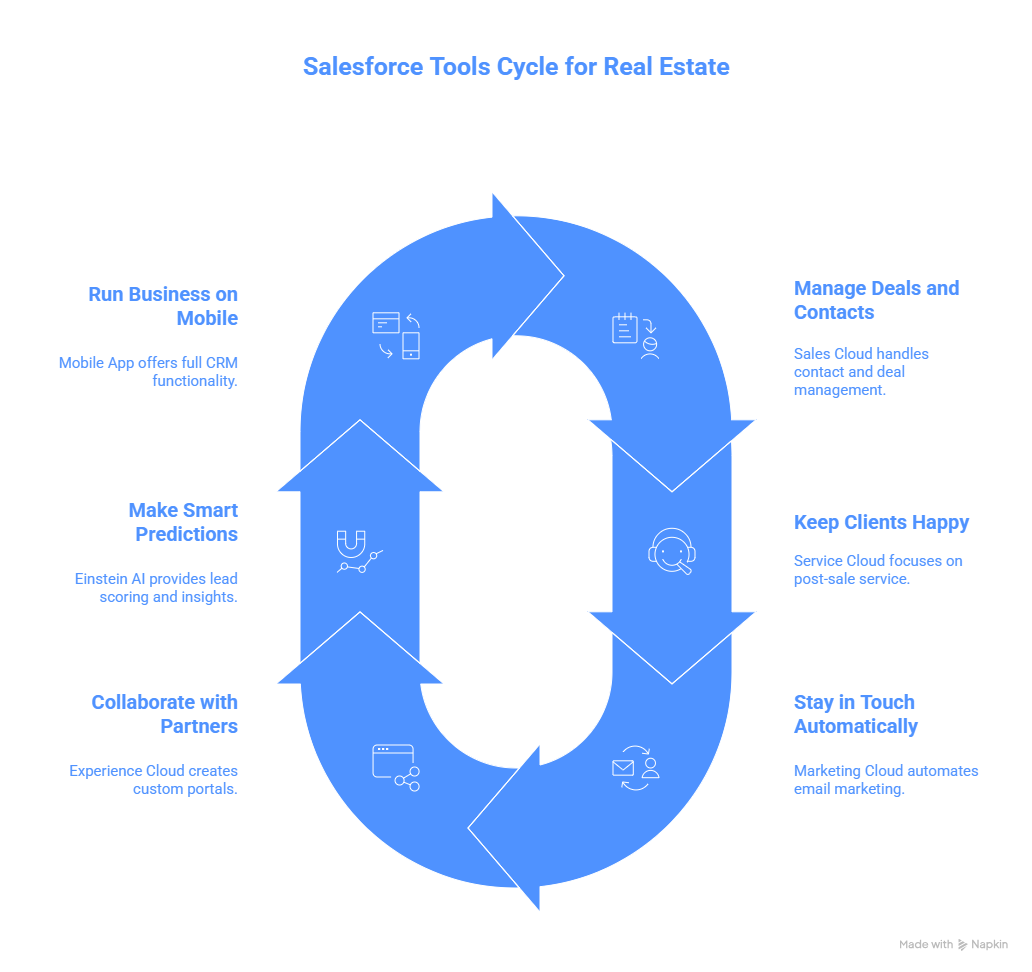
Sales Cloud – Managing Your Deals and Contacts
Sales Cloud is the foundation where contacts, opportunities, and deals live. It handles contact management, opportunity tracking, activity logging, and forecasting.
Service Cloud – Keeping Clients Happy
Service Cloud focuses on post-sale service with case management, knowledge base, and omnichannel support.
Marketing Cloud – Staying in Touch Automatically
Marketing Cloud handles email marketing automation, audience segmentation, journey builder, and ROI tracking.
Experience Cloud – Working with Partners and Teams
Experience Cloud creates custom portals for clients, partners, and team collaboration.
Einstein AI – Smart Predictions for Your Business
Einstein provides lead scoring, next best action suggestions, opportunity insights, and email insights.
Mobile App – Running Your Business from Your Phone
The Salesforce mobile app puts full CRM functionality in your pocket with the ability to update records, access information anywhere, and use mobile-optimized workflows.
Solving Your Daily Real Estate Headaches with Salesforce
Never Lose a Lead Again
Salesforce eliminates lead loss through web-to-lead forms, email-to-lead functionality, third-party integration, and lead assignment rules.
Stop Forgetting to Follow Up
Task automation, email sequences, reminder notifications, and activity history ensure you never miss a follow-up.
Managing Multiple Clients at the Same Time
List views and filters, queue management, calendar integration, and batch operations make managing dozens of clients manageable.
Keeping Track of Showings and Open Houses
Showing feedback forms, open house sign-in, and buyer feedback aggregation capture valuable information that would otherwise get lost.
Organizing Property Details in One Place
Custom objects for properties, linking properties to opportunities, document storage, and property matching automation centralize everything.
Connecting with Zillow, Realtor.com, and Other Sites
Salesforce integration with major real estate platforms means leads from Zillow appear in Salesforce within minutes. MLS integration, IDX feed integration, and marketing tool connections complete your ecosystem.
What Makes Salesforce Different for Real Estate?
Customizing Salesforce for How You Actually Work
Custom fields and objects, custom workflows and automation, page layouts for different roles, and custom apps let you build exactly what you need.
Connecting All Your Real Estate Tools Together
Salesforce integrates with lead sources, email and communication tools, document management, marketing platforms, accounting systems, and property data providers. Our Salesforce integration services ensure seamless connections between all your business tools.
Growing from Solo Agent to 100+ Person Brokerage
User scalability, organizational hierarchy, territory management, and role-based security mean you never outgrow Salesforce.
Getting Reports That Actually Make Sense
Customizable dashboards, drill-down analysis, scheduled reports, and real-time visibility provide sophisticated business intelligence.
Real Examples of Real Estate Success with Salesforce
How Zillow Uses Salesforce to Manage Millions of Leads
Zillow uses Sales Cloud for managing Premier Agent relationships and Service Cloud for Zillow Offers. Adopting Salesforce almost doubled sales team productivity, according to Zillow’s Sales Executive Manager.
How CREXI Grew Its Commercial Real Estate Business
CREXI uses Salesforce to manage relationships between property owners, brokers, and investors, orchestrating entire deals with multiple parties and stages.
A Solo Agent Who Tripled Their Income
A Denver agent went from $140,000 to $420,000 annual income in eighteen months using Salesforce through improved lead response time, follow-up consistency, and referral maximization.
Connecting Salesforce to Your Real Estate Business
Linking Your MLS and IDX Feeds
MLS and IDX integrations flow property data into Salesforce automatically. Most Salesforce implementation partners have experience with MLS integrations in their region.
Connecting Zillow and Other Lead Sources
Zillow leads import automatically into Salesforce with immediate lead routing, source tracking, and automated nurturing.
Syncing Your Email and Calendar
Two-way sync, email templates, meeting sync, and email tracking make email integration seamless.
Adding DocuSign for Electronic Signatures
Triggered document sending, status visibility, and compliance audit trail streamline the signature process.
Connecting Your Website Forms
Web-to-lead forms, progressive profiling, and landing page integration capture every website visitor.
Making Money with Salesforce – Real Numbers
How Much Salesforce Costs for Real Estate
Starter: $25/user/month. Professional: $80/user/month. Enterprise: $165/user/month. Unlimited: $330/user/month. Most real estate teams operate on Professional tier—five agents cost $400/month ($4,800/year).
What Results You Can Actually Expect
First 90 days bring immediate lead capture improvement and better follow-up consistency. Months 4-12 deliver more referrals and data-driven decisions. Year 2+ enables handling 2-3x client volume without proportional staff increases.
How Long Before You See Your Money Back
Solo agents: 3-6 months. Medium teams: 6-12 months. Large brokerages: 12-18 months. Focus on lead response time and follow-up consistency for the fastest ROI.
Comparing Costs to Other Real Estate CRMs
|
CRM Solution |
Starting Price |
What You Get |
Scalability |
|
Salesforce Professional |
$80/user/month |
Full CRM, automation, integrations |
Unlimited |
|
Follow Up Boss |
$99/agent/month |
Real estate-focused features |
Up to 50 agents |
|
Wise Agent |
$59/user/month |
Basic CRM |
Limited |
|
Real Geeks |
$299-$499/month |
CRM plus website |
Limited |
Getting Your Team to Actually Use Salesforce
Why Most CRM Projects Fail in Real Estate
Poor planning, trying to configure everything before rollout, insufficient training, no clear value proposition for users, and lack of leadership adoption cause most failures. That’s why many real estate firms partner with a Salesforce managed service provider to handle ongoing support, training, and optimization.
Making Salesforce Easy Enough for Everyone
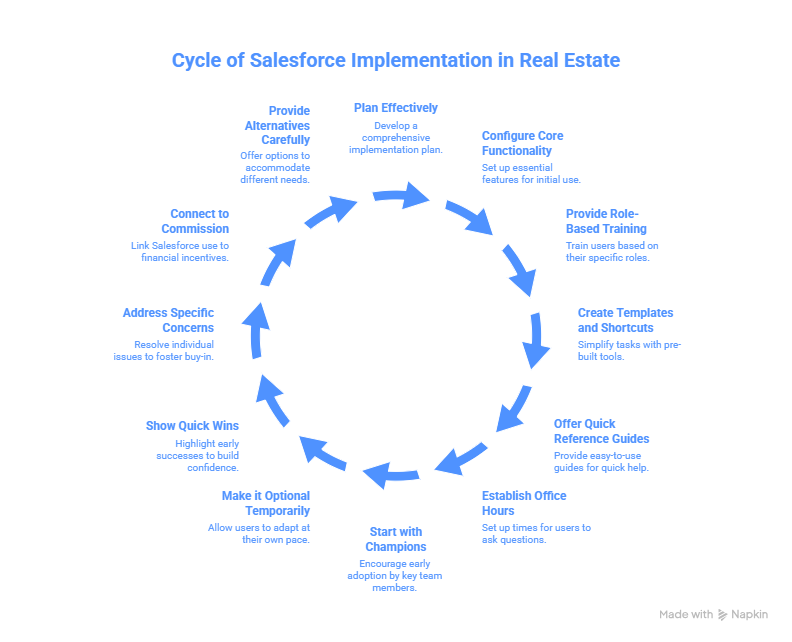
Start with core functionality, create role-based training, build templates and shortcuts, provide quick reference guides, and establish office hours for questions.
Training Your Agents Step by Step
Week 1: Essentials (logging in, finding contacts, logging activities). Week 2: Lead management. Week 3: Opportunity management. Week 4: Advanced features.
Getting Buy-In from Resistant Team Members
Start with champions, make it optional temporarily, show quick wins, address specific concerns, connect to commission, and provide alternatives carefully.
Starting with Salesforce in Your Real Estate Business
Should You Start Small or Go All In?
Start small if you’re a solo agent or small team with tight budget. Go bigger if you’re an established brokerage with 10+ agents and dedicated operations staff.
DIY Setup vs. Hiring a Consultant
DIY works for limited budgets and straightforward needs. Hire Salesforce consultants when you want results faster, need complex customization, or want to avoid common mistakes.
If you’re switching from another CRM, our Salesforce migration services can transfer your data cleanly and ensure zero disruption.
Your First 30 Days with Salesforce
Days 1-7: Foundation (training, setup, import contacts). Days 8-14: Core functionality (opportunity stages, reports, email integration). Days 15-21: Automation (templates, workflows, reminders). Days 22-30: Testing and training.
Common Mistakes to Avoid
Don’t over-customize too early, clean your data before migration, invest in change management, optimize for mobile, ensure executive sponsorship, and define success metrics upfront.
For complex customization needs, consider having a dedicated expert we can help you hire Salesforce developers experienced in real estate implementations.
Answering Your Real Estate Salesforce Questions
Is Salesforce Too Complicated for Real Estate?
Salesforce is powerful but manageable. 49% of customers are small businesses. The key is intentional simplicity—use 20% of features that deliver 80% of value.
Can I Use It on My Phone While Showing Properties?
Yes. The Salesforce mobile app provides nearly full functionality. You can pull up property details, review client preferences, take notes, log activities, and update opportunity stages.
What If I Switch Brokerages – Do I Keep My Data?
It depends on setup. Brokerage-owned instances mean contacts stay with the company. Agent-owned instances mean you keep your data. Clarify ownership before implementing.
Does It Work for Commercial and Residential?
Yes to both. Salesforce’s flexibility accommodates either market through custom objects, relationship mapping, and detailed opportunity tracking.
Can I Try It Before Buying?
Salesforce offers 30-day free trials. Many implementation partners also offer proof-of-concept engagements where they configure Salesforce for your business on a trial basis.
What’s Next for Real Estate CRM Technology
AI That Predicts Which Leads Will Actually Buy
Near-future capabilities include predicting likelihood to buy with 80%+ accuracy, identifying optimal contact timing, automatic conversation summarization, and sentiment analysis. Explore Agentforce implementation to get started with these AI-powered tools today.
Virtual Property Tours Inside Your CRM
Integration between virtual tour technology and CRM will track which rooms buyers viewed, how long they spent in each space, and whether they shared the tour.
Automated Market Reports for Your Clients
Dynamic report generation will deliver monthly emails with neighborhood statistics, recently sold comparables, and market trend analysis customized to each contact’s interests.
Voice Commands and Smart Assistants
Voice interfaces will make data entry during driving or showings completely seamless.
Comparing Salesforce to Other Real Estate CRMs
Salesforce vs. Follow Up Boss
Follow Up Boss wins on easier setup and real estate-specific features. Salesforce wins on scalability, customization depth, integration ecosystem, and advanced automation. Verdict: Follow Up Boss for small residential teams; Salesforce for growing businesses.
Similarly, if you’re currently using other CRM platforms like Zoho, we offer comprehensive support for your migration. Read our guide on how to migrate Zoho to Salesforce to make the transition seamlessly.
Salesforce vs. Wise Agent
Wise Agent wins on price and simplicity. Salesforce wins on customization, automation sophistication, and reporting. Verdict: Wise Agent for price-sensitive small teams; Salesforce for growth-focused businesses.
Salesforce vs. Real Geeks
Real Geeks wins on integrated website and built-in lead generation. Salesforce wins on flexibility and team management at scale. Verdict: Real Geeks for all-in-one simplicity; Salesforce for best-of-breed integration.
When Salesforce Makes Sense (and When It Doesn’t)
Salesforce makes sense when you’re planning to grow, have 10+ team members, need extensive customization, work in commercial real estate, or value integration ecosystem.
Salesforce doesn’t make sense when you’re a solo agent with simple needs, want the absolute lowest price, need full operation in under a week, or have zero technical resources.
Conclusion
Real estate runs on relationships, timing, and trust. Salesforce for real estate centralizes the information and automates the processes that make those three things consistent and scalable.
The agents and brokerages thriving aren’t necessarily the ones working hardest. They’re the ones working smartest, leveraging technology to multiply effectiveness. You need systems that capture every lead, follow up consistently, and scale with your growth. Choose tools that position you for the market you want to compete in tomorrow, not just the business you run today.
FAQs
Can Salesforce be used for real estate?
Yes, Salesforce works exceptionally well for real estate. 4,000+ real estate firms use Salesforce, including major players like Zillow. It adapts to residential, commercial, property management, and real estate investment businesses.
What is the best CRM for realtors?
The “best” depends on your specific needs. For small residential teams, Follow Up Boss or Real Geeks offer easier setup. For growing businesses or those needing extensive customization, Salesforce provides superior scalability.
How much is Salesforce real estate CRM?
Salesforce pricing: Starter $25/user/month, Professional $80/user/month, Enterprise $165/user/month, Unlimited $330/user/month. A five-person team on Professional tier costs about $4,800 annually.
How long does Salesforce implementation take for real estate?
Basic implementation takes 30-90 days for small teams. Medium teams need 3-6 months. Large brokerages may spend 6-12 months. You can start seeing value within the first few weeks.
Does Salesforce integrate with MLS systems?
Yes, most MLS systems integrate with Salesforce through direct API connections or middleware solutions, allowing property data to flow automatically.
Is Salesforce difficult to learn for real estate agents?
Salesforce has a learning curve, but it’s manageable with proper training. Most agents become proficient in essential functions within 2-4 weeks.
Can I use Salesforce on my mobile phone?
Absolutely. The Salesforce mobile app provides nearly full functionality for iOS and Android. You can access contacts, update deals, log activities, and communicate with clients from your phone.
What’s the ROI of Salesforce for real estate?
Improved lead conversion from 1% to 2.5% can generate over $1 million in additional annual revenue for an active agent, far exceeding typical CRM costs of $5,000-$10,000 annually.