
The traditional sales model where more revenue requires more salespeople—is obsolete. Today’s reality: teams stretched thin, with administrative tasks consuming 64% of a rep’s day. Sales teams spend up to 64% of their time on non-revenue-generating activities, which explains why even high-performing reps struggle to maintain momentum.
This challenge isn’t unique to sales customer service teams spend similar time on data entry, case logging, and routine inquiries. Agentforce for customer service frees service reps from repetitive work by having AI handle frequently asked questions, returns, account updates, and standard requests—allowing human agents to focus on complex problem-solving and relationship building just like high-performing salespeople do.
Forward-thinking organizations use Salesforce for sales reps differently. They deploy AI-powered workflows that transform how sellers engage, qualify, and close deals. With high-performing sales teams nearly twice as likely to use AI than low-performing teams, the competitive gap between optimized and underutilized Salesforce implementations is widening rapidly.
What Is the Role of Salesforce for Sales Reps?
Salesforce serves as the operational backbone for modern sales organizations. At its core, Salesforce for sales reps functions as an intelligent workspace that unifies customer data, automates workflows, and surfaces actionable insights exactly when reps need them.
Traditional CRMs were filing cabinets. Salesforce today is more like a sales assistant that never sleeps—tracking interactions, identifying high-potential opportunities, generating meeting prep materials, and coaching reps on calls in real-time.
The platform’s architecture mirrors the sales journey. Leads are prospective customers who’ve shown interest, which become Contacts when qualified, unified under Accounts representing companies, and tracked as Opportunities progressing through sales stages until they’re Closed/Won or Closed/Lost. This structure ensures nothing falls through the cracks while providing complete pipeline visibility.
What makes Salesforce particularly valuable today: it’s shifting from a system of record to a system of action. Agentforce for Sales brings autonomous agents directly into your sales team’s flow of work, performing tasks like prospecting research, summarizing records, and planning their day. Reps spend less time updating spreadsheets and more time actually selling.
Direct Benefits for Day-to-Day Sales Activities
Salesforce is great for organization, ensuring customer information is accurate and up to date. This accuracy builds confidence in customer conversations, allowing reps to make genuine connections rather than fumbling with outdated contact details.
Mobile capabilities deserve special attention. Reps can update opportunities immediately after client meetings, check pipeline status between appointments, and respond to urgent requests without being chained to their desks. Changes made in the mobile app are instantly reflected in reports and dashboards, ensuring everyone operates from the same real-time information. Proper Salesforce implementation services ensure these mobile capabilities are optimized for your team’s specific workflows.
Why is salesforce so highly regarded a place to work in sales
byu/Cheap_Vacation_7809 intechsales
Key Features of Salesforce for Sales Reps
Understanding which Salesforce features directly impact rep productivity helps organizations prioritize implementation efforts. The best practices for using Salesforce for sales reps focus on tools that eliminate bottlenecks rather than add complexity.
Intelligent Lead and Opportunity Management
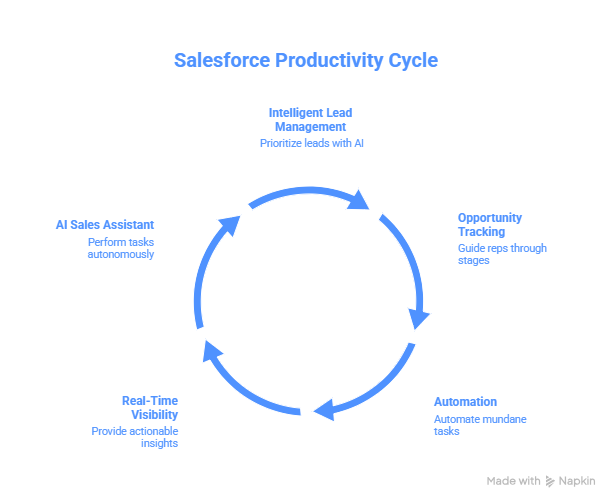
Salesforce training for sales reps should emphasize platform’s prospect progression capabilities. Lead scoring uses AI to evaluate customer behavior and engagement levels, automatically prioritizing which prospects deserve immediate attention. AI evaluates customer behavior, engagement levels, and historical data to assign accurate lead scores, allowing reps to focus on the most promising leads.
Opportunity tracking provides guided paths that highlight important fields at each stage, reducing mental load on reps and ensuring data consistency. Lead assignment rules ensure leads are routed to the most qualified sales rep based on criteria, while lead queues provide backup if the primary rep isn’t available. This protects revenue opportunities during vacations, sick days, or territory transitions.
Automation That Actually Saves Time
Better Salesforce tips for sales reps focus on automating the right things. Without automation, sales reps would need to close deals and send thank-you notes manually, but with Salesforce, the account type can automatically change from Prospect to Customer once the sales stage changes to closed won, and thank-you emails with onboarding resources can be sent automatically.
Workflow rules and approval processes handle mundane tasks that don’t require human judgment. When an opportunity sits in the same stage too long, the system can automatically assign a task to the owner for review. Big Deal Alerts notify managers when significant opportunities approach close, enabling timely coaching interventions.
The real power emerges with Agentforce capabilities. Reps decreased account research time from an hour to just 5 or 10 minutes—a decrease of up to 92%—with Agentforce automating manual tasks and streamlining workflows. This isn’t marginal improvement; it’s a fundamental shift in how reps allocate their time. Similar time savings benefit customer service teams using Agentforce for customer service.
Forward-thinking organizations use Salesforce for sales reps differently. They deploy AI-powered workflows that transform how sellers engage, qualify, and close deals. With high-performing sales teams nearly twice as likely to use AI than low-performing teams, the competitive gap between optimized and underutilized Salesforce implementations is widening rapidly.
Dashboards and Real-Time Visibility
Salesforce dashboards for sales reps need to answer “what should I do right now?” Dynamic dashboards show each user their own stats based on role hierarchy, meaning reps see their individual performance while managers view team-wide metrics from the same dashboard.
Salesforce can automatically notify sales reps when an opportunity is close to being won using Big Deal Alert, and Opportunity Update Reminders schedule status updates to be emailed to the team. This prevents opportunities from stalling due to simple oversight.
Reports should focus on actionable insights: track opportunities that haven’t had activity in X days, analyze which activities correlate with wins, and monitor conversion rates at each stage.
Agentforce: The AI Sales Assistant
Agentforce represents a fundamental rethinking of how technology supports sellers. It doesn’t just surface insights; it performs the work, saving time and delivering value directly in your Salesforce org.
The Sales Development agent can nurture leads autonomously based on your engagement rules, while the Sales Coaching agent joins prospecting calls to provide instant feedback.
Similar AI capabilities are transforming customer service operations. Agentforce for customer service uses autonomous agents to resolve 75% of customer inquiries without human intervention, achieving up to 8x ROI—demonstrating that AI agents work across the entire customer lifecycle from acquisition to retention.
How Does Salesforce Help Companies Improve Sales Processes
Process improvement isn’t about technology alone—it’s about removing friction from your sales motion while maintaining consistency and visibility.
Standardizing Without Stifling
Your sales process depends on the type of service you offer, your revenue model, and the key milestones your prospects take to become customers. Path functionality guides reps through each stage with contextual tips and highlighted fields, reducing ramp time for new hires and ensuring veterans don’t skip important steps during busy periods.
Making the process as easy as possible for your sales team and removing their roadblocks should be your number one priority. This means sitting down with top and bottom performers to understand how they actually move through stages and close deals, then building your Salesforce configuration to match reality rather than an idealized process nobody follows. Expert guidance through Salesforce implementation can help translate these insights into effective system configuration.
Unifying Fragmented Data
One of the most critical ways Salesforce improves sales processes is by addressing data fragmentation. Research shows that 81% of IT leaders report that data silos are actively hindering digital transformation efforts. When customer context is trapped in different systems, reps can’t deliver the personalized experience that modern buyers expect.
Salesforce Data Cloud solves this by unifying structured and unstructured data into a single view. Approximately 80% of enterprise data is unstructured (emails, documents, images), making it difficult to analyze using traditional tools. Data Cloud processes this information, providing AI agents with the proprietary context needed to produce accurate, actionable insights. Professional Salesforce integration services can help connect Salesforce with your essential tools and core systems to create this unified view. UEM Sunrise Berhad achieved up to 20% conversion rates using Data Cloud, demonstrating how data accessibility directly impacts revenue.
Enabling Sales and Marketing Alignment
Salesforce should integrate and automate lead acquisition, lead management, and lead conversion processes for both marketing and sales, calculating lead scores, transferring qualified leads, measuring lead-to-opportunity duration and conversions, and returning stalled leads back to marketing for continued nurturing.
This alignment prevents lead leakage—the silent killer of pipeline health. Companies with aligned sales and marketing departments achieve an average of 32% annual revenue growth, according to Forrester Research.
Providing Forecasting Accuracy
Reliable forecasts enable better business decisions. AI uses historical data and engagement metrics to predict which leads are most likely to convert, allowing reps to prioritize their efforts effectively. This predictive capability extends to identifying which deals might slip, which customers are at risk for churn, and where to focus competitive intelligence efforts.
How to Use Salesforce for Sales Reps
Mastering the Core Objects
Every rep needs to understand information flow. Sales representatives can customize Accounts by Type field—Prospect Accounts, Customer Accounts, or Partner Accounts—and Accounts can represent Opportunities that remain Opportunities until Closed/Won or Closed/Lost. Leads represent unqualified interest, Contacts are people, Accounts are companies, and Opportunities are specific deals.
Implementing Effective Automation
Start with automations delivering immediate value. Modern best practices employ automated alerts that ping reps for significant events—new lead assignments or buying process changes. Bidirectional Slack/Salesforce integrations allow automated alerts and one-click approval buttons. Auto-create contacts from calendar invites to eliminate data entry.
Leveraging Mobile
Field reps can’t wait until they’re at desks. Configure mobile-optimized layouts showing critical fields first. Encourage immediate opportunity updates after meetings.
Building Sales Methodology Integration
Sales reps with optimized methodologies achieve 11% higher win rates than those with informal methods, increasing another 6% when integrated with Salesforce technology. Embed your framework (MEDDIC, Challenger, Solution Selling) into configuration through custom fields, validation rules, and methodology-tracking dashboards. Salesforce customization services can help tailor the platform to support your unique workflows and methodology requirements. Sellers using formal sales methods are up to 40% more successful.
Optimizing for Data Quality
Establish data quality standards enforced through validation rules. The top benefit of AI in sales is improved data quality and accuracy. Sales Cloud’s AI functions analyze territory data to identify high-potential prospects.
| Salesforce Best Practice | Implementation Approach | Expected Impact | Common Pitfall to Avoid |
| Lead Scoring & Assignment Rules | Configure AI-powered lead scoring; set up automatic routing based on territory/expertise | Reduced lead response time; improved conversion rates | Over-complicating rules that create confusion |
| Opportunity Path Guidance | Build stage-specific paths with key field highlights and contextual tips | Faster ramp time for new reps; improved data consistency | Making paths too prescriptive and inflexible |
| Mobile Optimization | Configure mobile layouts prioritizing critical fields; enable offline access | Real-time updates from field; better pipeline accuracy | Forcing desktop workflows onto mobile screens |
| Automated Alerts & Notifications | Set up Slack/email alerts for key events; use workflow rules for stale opportunities | Proactive engagement; reduced opportunity slippage | Alert fatigue from too many low-value notifications |
| Agentforce Implementation | Start with high-volume, low-complexity tasks; gradually expand to strategic workflows | 30-40% time savings on routine tasks; improved rep capacity | Deploying without clean data foundation |
How do your Sales reps log their leads?
byu/Haensfish insalesforce
Pros of Salesforce for Sales Reps
Unified Platform for Customer 360
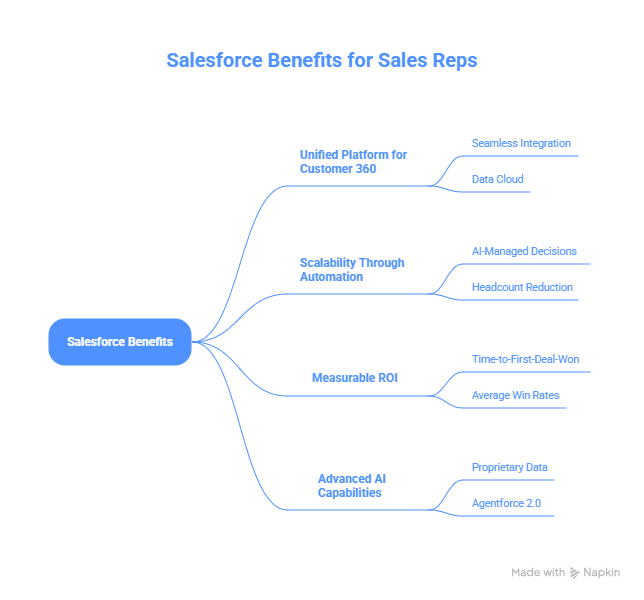
The most significant advantage is having one source of truth for customer relationships. When sales, service, and marketing operate within the Salesforce ecosystem, context doesn’t get lost. Salesforce has 4,000+ pre-built applications for seamless integration.
Data Cloud unifies both structured and unstructured data—addressing that approximately 80% of enterprise data is unstructured. This grounds AI agents in accurate context.
Scalability Through Automation
Salesforce breaks the headcount-for-revenue assumption through automation. Gartner predicts that by 2028, at least 15% of day-to-day work decisions will be autonomously managed by agentic AI, up from 0% in 2024.
Measurable ROI
The platform tracks time-to-first-deal-won, average win rates, and sales pipeline value. Salesforce Marketing Cloud customers demonstrated a 299% ROI over three years. Advantech achieved a 50% reduction in IT cycle time.
Advanced AI Capabilities
Salesforce’s AI is grounded in your proprietary data and trained on CRM-specific tasks. Agentforce 2.0 features pre-built agent skills spanning CRM, Slack, Tableau, and AppExchange.
Cons of Salesforce for Sales Reps
Complexity and Learning Curve
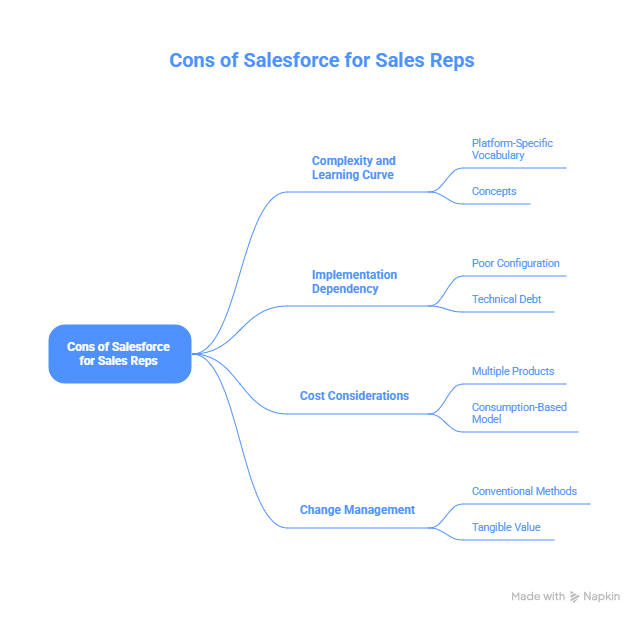
Companies use less than 23 percent of Salesforce’s capabilities on average. New reps face a steep learning curve with platform-specific vocabulary and concepts.
Implementation Dependency
Poor configuration creates technical debt. The industry demand for multi-cloud implementation skills outpaces supply. Organizations can hire Salesforce developers with expertise in complex implementations to ensure proper configuration from the start.
Cost Considerations
Maximizing value often requires multiple products. Agentforce uses a consumption-based model with Flex Credits (customers get 100,000 at no cost through Salesforce Foundations).
Change Management
Conventional Salesforce methods often get abandoned within months because they require too many steps. Demonstrating tangible value quickly is essential for adoption.
Why Salesforce Stands Out Among Traditional CRM Systems
Platform vs. Point Solution
Most CRMs are products. Salesforce is a platform enabling composition—you can combine capabilities to solve unique business problems without custom coding. The AppExchange hosts thousands of pre-built extensions. Small companies can start with basic Sales Cloud and expand to Revenue Cloud, Data Cloud, and Agentforce as needs evolve, without switching vendors. Organizations moving from legacy systems or older Salesforce versions can leverage Salesforce migration services to ensure a smooth transition.
Agentic AI Differentiator
Agentforce brings together apps, data, metadata, and agents on a single platform. Agentforce’s AI agents can respond to inputs, make decisions, and autonomously take action at infinite scale, working 24/7. They don’t just suggest actions—they execute them within established guardrails.
Data Cloud Foundation
Salesforce Data Cloud unifies enterprise data at scale, utilizing Zero Copy capabilities to access siloed data from external data lakes like AWS and Snowflake. Data Cloud surpassed 50 trillion records, doubling year over year.
Trust and Governance
The Einstein Trust Layer prevents prompt injections, filters toxic outputs, and ensures every agent action is recorded and traceable. Agent Guardrails control topic access and restrict sensitive actions.
Key Takeaways
Implementing Salesforce best practices for sales reps isn’t about following a checklist—it’s about fundamentally rethinking how your sales organization operates.
- Start with process before technology. A critical realization in 2024 was that technology alone is insufficient; successful organizations prioritize defining clear business processes and addressing technical debt before layering in complex solutions.
- Prioritize data unification as your foundation. The paramount priority is data unification—achieving a complete Customer 360 view by integrating all enterprise data via Data Cloud is essential for maximizing the potential of autonomous AI.
- Focus automation on high-volume, low-complexity tasks first. Automating the most mundane, repetitive tasks—specifically data entry, transcription, and basic lead qualification—delivers immediate user satisfaction and efficiency gains.
- Build internal capability rather than relying solely on external consultants. Long-term success requires internal professionals who can maintain the solution, map optimized processes, and address ongoing technical debt. However, strategic Salesforce consulting services can accelerate implementation and provide expertise during critical phases.
- Measure outcomes, not just activity. Every investment should be tied to clear ROI expectations—whether it’s reduced IT cycle time, increased conversion rates, or improved sales velocity.
- Human-centered design drives adoption. The goal is augmentation, not replacement, with communication, empathy, and critical thinking as critical differentiators.
87% of business buyers expect sales reps to act as trusted advisors, which requires reps to spend more time on strategic relationship building and less on administrative tasks. Organizations that successfully deploy Salesforce with Agentforce create that capacity; those that don’t will struggle to keep pace.
Ready to transform your sales organization with Salesforce?
- For Sales Leaders: Contact our team to assess your current Salesforce utilization and identify quick-win opportunities for improving rep productivity.
- For IT Decision-Makers: Schedule a consultation to discuss Data Cloud implementation and Agentforce integration strategies.
- For Sales Ops Professionals: Download our Salesforce optimization checklist covering automation workflows, dashboard design, and data quality frameworks.
FAQs
How much time can Salesforce automation really save?
The data is compelling. Organizations using Agentforce decreased account research time from an hour to just 5 or 10 minutes—a 92% reduction. Early Agentforce users saw up to 30% time savings on routine CRM tasks. The exact amount depends on your current process efficiency and which tasks you automate first.
What are the easiest automations to start with?
Begin with automated alerts for new lead assignments, email notifications for stale opportunities, and workflow rules that update record types based on stage changes. Automating account type changes from Prospect to Customer when deals close, and sending thank-you emails with onboarding resources automatically, provides immediate value without complex configuration.
How does Agentforce help sales reps save time?
Agentforce utilizes your CRM and company data to help reps complete everyday tasks like prospecting research, summarizing records, and planning their day. It handles monotonous work autonomously—deal record updates, account research, administrative tasks—allowing sellers to focus on building customer relationships.
How do I get my team to adopt these practices?
Focus on removing friction, not adding monitoring. Make the process as easy as possible by sitting down with reps to understand what’s working and what’s not, reducing the number of clicks they take, and making data entry easier. Demonstrate tangible time savings early and celebrate reps who use the system effectively.
What’s the typical ROI timeline for Salesforce optimization?
Quick wins from basic automation appear within weeks. Organizations implementing Agentforce report 40% faster case resolutions and 25% increases in lead conversions. Full ROI from comprehensive Data Cloud implementation typically materializes within 6-12 months, with Salesforce Marketing Cloud customers demonstrating 299% ROI over three years.
Can small sales teams benefit from these strategies?
Absolutely. Customers can begin using Flex Credits for free with Salesforce Foundations, which includes 100,000 Flex Credits at no cost. Small teams often see faster time-to-value because they have fewer legacy processes to unwind and can implement changes more quickly than large enterprises.