AI Want to work smarter with AI? See how Agentforce fits your business.

Get Started

Heroku Development Services

Build and Run Cloud Apps Without Platform Overhead

Launch and manage applications faster without handling infrastructure. We provide Heroku development services to design, deploy, and support apps using managed runtimes, add-ons, and data services, with AI used only where it fits real workloads.

Turn-Complex-Data-Into-Clear-Decisions

What Makes Folio3 a Trusted Partner for Heroku Development Services

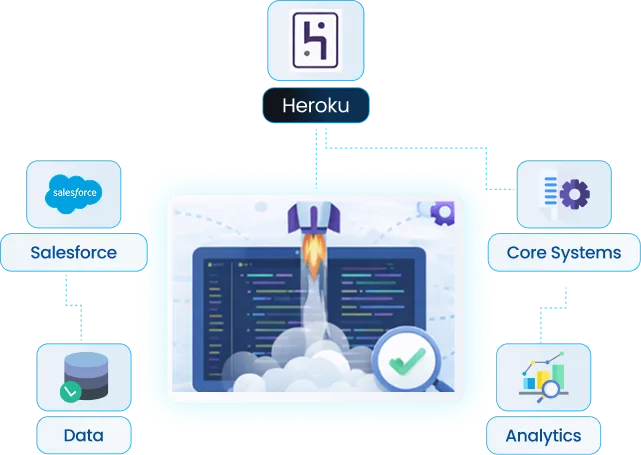
Folio3 works with Heroku as a managed application platform, not just a hosting layer. Through our Heroku development services, we design applications around dynos, release pipelines, and add-ons so teams can ship features without maintaining servers, build systems, or operating environments.

Our team set up Postgres, managed services, and Salesforce data sync to support real production needs. These include transactional traffic, background processing, and secure data exchange. When isolation is required, we architect workloads using Private Spaces to match how production systems actually run.

For AI and automation use cases, clients rely on our teams to host controlled services and custom logic that connect cleanly with Salesforce. This keeps execution secure, observable, and aligned with platform governance, without adding operational overhead.

Our Certifications

Work with some of the most experienced certified Salesforce consultants and specialists, boasting expertise across the entire ecosystem.

Heroku Services That Support Scalable Applications

We provide full-scale Heroku consulting services, covering application design, migration, and long-term operations. Our work aligns with supported runtimes, the native deployment model, and built in managed services.

Heroku App Architecture Design

Applications are structured around dynos, buildpacks, and add-ons, so releases stay predictable as usage grows. Heroku development services focus on consistent environments, controlled configuration, and deployment patterns that reflect real production runtime behavior.
Read More

Heroku Cloud Application Development

Web and API applications are built using supported languages and frameworks, designed for stateless execution, background workers, and release pipelines. Hire Heroku developers to align application code with platform constraints during real-world operation.
Read More

Salesforce Integration via Heroku Connect

Data synchronization is configured using Heroku Connect to sync Salesforce objects with Heroku Postgres. We define mappings, sync frequency, and data volume limits so applications query CRM data reliably under production load conditions.
Read More

Application Migration to Heroku

Applications are migrated from self managed infrastructure or other platforms by reshaping services, dependencies, and release workflows. Components are adjusted to fit dyno-based execution, ephemeral filesystems, and Heroku deployment workflows used in production environments consistently.
Read More

Heroku Logging and Monitoring Setup

Logging and monitoring are configured using Heroku-supported add-ons to track request flow, errors, and dyno resource usage. Visibility focuses on runtime behavior, service health, and application stability during peak traffic across production workloads and regions.
Read More

Ongoing Heroku Platform Support

Post-launch support covers configuration updates, dyno scaling, and operational reviews as part of ongoing support and maintenance. Applications remain stable as traffic shifts and platform features evolve without downtime or configuration drift.
Read More

Our Salesforce Consulting Service Success Stories

Keep your Heroku applications stable with expert platform support.

Our Heroku Expertise

Application Runtime Management

Heroku applications are designed around dynos, stateless execution, and horizontal scaling rather than fixed servers. This work begins with focused consulting that guides runtime choices as traffic changes across environments and release cycles.

We help you with:

  • Dyno sizing decisions
  • Stateless app design
  • Background worker setup
  • Release phase configuration

Data Services Integration

Data layers are built using Heroku Postgres and supported add-ons instead of custom-managed databases. This integration approach allows applications to handle growth, connection limits, and backups without added database operational overhead.

We help you with:

  • Postgres configuration
  • Connection pooling
  • Read replica setup
  • Data backup planning

Salesforce Integration

Salesforce integrations are structured around Heroku Connect and controlled sync rules rather than direct API polling. That keeps application data aligned with Salesforce objects during ongoing development and production usage.

We help you with:

  • Object mapping
  • Sync rule setup
  • Data volume planning
  • Error handling design

Secure Network Architecture

For regulated workloads, applications run inside Heroku Private Spaces with network isolation and controlled routing. This supports compliance needs by separating traffic and restricting access at the platform level.

We help you with:

  • Private Space setup
  • Network isolation
  • Compliance alignment
  • Secure service access

CI and Release Pipelines

Release pipelines are aligned with Heroku’s buildpacks, slug compilation, and promotion flow rather than custom deployment scripts. This reduces deployment risk during platform migration and ongoing release activity.

We help you with:

  • Pipeline configuration
  • Review app setup
  • Release validation
  • Rollback planning

Observability and Operations

Production visibility is built using Heroku-supported logging and monitoring add-ons rather than custom tooling. Teams track errors, request flow, and dyno behavior as applications run under real traffic.

We help you with:

  • Log aggregation
  • Error tracking
  • Resource usage reviews
  • Incident response workflows

AI-Driven Application Execution

Heroku supports Agentforce-driven workflows by hosting controlled services that execute custom logic and actions triggered by intelligent agents in Salesforce. Applications are configured to expose only approved tools and endpoints, keeping agent execution observable, governed, and aligned with platform controls.

We support:

  • Secure agent action hosting
  • Controlled tool access
  • Runtime isolation
  • Execution logging
  • Salesforce integration
  • Deployment governance

Ready to Hire Heroku Developers Today?

We help you build applications and support on a platform designed for managed operations and predictable releases.

Driving Change for Growing Companies with Salesforce Services

Majorkey

We used Folio3 over the last 3+ years for many projects, including org merges, complicated workflows and enhancements. Folio3 is was very detailed in the work. They are experts. They can explain complicated tasks so even the novice in the room can understand. Appropriate and reasonable timelines are assigned so that there are no issues with any tasks for transition. The project closed without any hang ups or hold ups and we continue to do enhancements on the application with Folio3.

testimonial-sunhero-logo

Sunhero

Folio3 did a great job in scoping the request and keeping communication going throughout the task
This was a very ambiguous request and they managed to troubleshoot the issue and explore different options. I would hire them again

Frequently Asked Questions (FAQs)

Costs depend on dyno usage, data services, add-ons, and network configuration. We estimate pricing based on expected workload and environmental needs.

You should hire Heroku developers when applications depend on dynos, buildpacks, add-ons, or Heroku Connect. Platform-specific experience helps avoid designs that conflict with stateless runtimes, scaling behavior, and managed service limits.

Timelines vary by scope. New application builds usually take weeks, while migrations depend on how closely the existing system fits Heroku’s model.

Yes, when designed correctly. Private Spaces, managed data services, and controlled integrations support enterprise requirements.

Yes. Heroku Connect syncs selected Salesforce objects with Heroku Postgres so applications can query CRM data directly.

A Heroku consulting company helps avoid design choices that conflict with how the platform operates, reducing rework and production issues.